Triple Whale vs BlueAlpha.ai: Complete Comparison Guide
Compare Triple Whale vs BlueAlpha.ai for marketing analytics. Learn which platform fits your ecommerce attribution and marketing mix modeling needs.
Choosing the right marketing analytics platform can feel overwhelming. Dozens of tools promise better attribution, clearer insights, and higher ROAS. But not all platforms solve the same problem—and picking the wrong one costs you months of integration headaches and misallocated budget.
Triple Whale vs BlueAlpha.ai represents a particularly interesting comparison because these platforms approach marketing measurement from fundamentally different angles. One focuses on pixel-based tracking for ecommerce. The other builds statistical models that work without tracking individual users at all.
This guide breaks down exactly how each platform works, where they excel, and which one fits your specific situation.
Why This Comparison Matters
The marketing measurement landscape has fractured. iOS 14.5 changed everything, and cookie deprecation keeps advancing. Attribution tools that worked flawlessly in 2019 now deliver incomplete data that leads to poor decisions.
Both Triple Whale and BlueAlpha.ai emerged as responses to this shift, but their solutions diverge significantly. Understanding these differences matters because measurement methodology directly impacts how you allocate budget across channels.
According to Nielsen, the average marketing campaign achieves only 50% of its potential ROI due to suboptimal allocation. The right measurement approach isn't academic—it's a competitive advantage worth millions in recovered efficiency.
For context on why measurement methodology matters so much, our marketing effectiveness measurement guide covers the foundational concepts both platforms build upon.
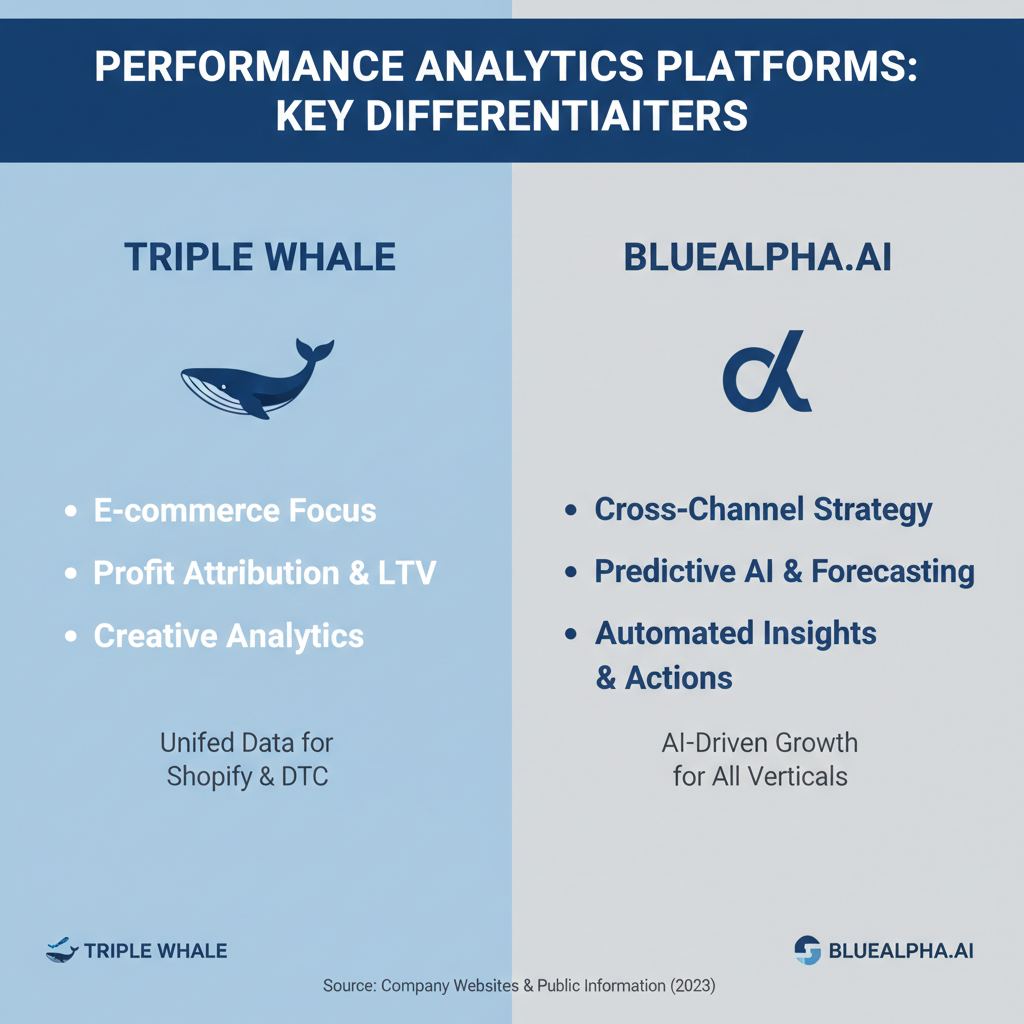
Both platforms tackle post-privacy marketing measurement—but their approaches couldn't be more different
Understanding the Core Difference: Pixel Tracking vs Statistical Modeling
Before diving into features, you need to understand what separates these platforms fundamentally.
Triple Whale's Approach: First-Party Pixel Tracking
Triple Whale built its platform around a proprietary pixel that tracks customer interactions across your website. Think of it as a more sophisticated version of the Facebook pixel—but owned by you.
The pixel captures first-party data directly: page views, add-to-carts, purchases, and customer journey touchpoints. Triple Whale then applies various attribution models to this data, helping you understand which marketing channels drove which conversions.
Core philosophy: Collect your own data, reduce reliance on platform-reported metrics, and make faster decisions based on real-time information.
BlueAlpha.ai's Approach: Marketing Mix Modeling
BlueAlpha.ai takes a completely different path. Instead of tracking individual users, it uses statistical modeling to measure marketing impact at the aggregate level.
Marketing mix modeling analyzes the relationship between your marketing spend and business outcomes over time. By examining patterns across weeks or months of data, MMM isolates the incremental contribution of each channel without needing to track any individual user.
Core philosophy: Privacy-compliant measurement that proves causation, not just correlation, and delivers optimization recommendations you can actually trust.
This distinction—pixel-based attribution versus statistical modeling—shapes everything else about these platforms. Understanding it helps you evaluate which approach fits your business reality. Our guide on media mix model marketing attribution explains these methodological differences in detail.
Triple Whale: Deep Dive
Let's examine what Triple Whale actually delivers and where it excels.
Platform Overview
Triple Whale launched in 2021 with a specific mission: help DTC brands reclaim visibility lost to iOS privacy changes. The platform has since evolved into a comprehensive ecommerce analytics suite, but attribution remains its core value proposition.
The company has raised significant venture capital and built a large customer base, primarily among Shopify merchants. Their tight integration with the Shopify ecosystem makes deployment straightforward for online retailers.
Key Features
Triple Pixel (First-Party Data Collection)
Triple Whale's signature feature. The pixel installs on your website and captures customer interactions using first-party cookies. This data feeds into their attribution models and provides a unified view of customer behavior.
Because the data is first-party (collected directly by you), it's less affected by browser restrictions than third-party tracking. However, it still relies on cookies and client-side tracking, which have their own limitations.
Real-Time Reporting Dashboard
Triple Whale excels at presenting data clearly. The dashboard consolidates metrics from connected platforms—Meta Ads, Google Ads, TikTok, Klaviyo, and more—into a single view. You see ROAS, customer acquisition cost, lifetime value, and cohort analysis without switching between platform dashboards.
Real-time data enables rapid campaign adjustments. For brands running high-velocity testing programs, this speed matters considerably. Gartner's marketing research confirms that organizations with faster feedback loops optimize campaigns 40% more effectively.
Multiple Attribution Models
The platform offers several attribution approaches:
- Last-click attribution
- Multi-touch attribution (MTA)
- Marketing mix modeling (recently added)
- Incrementality testing
This flexibility lets you compare how different models assign credit, though interpretation still requires analytical sophistication. Understanding how to optimize media budgets across these models helps you make better use of the data.
Shopify-Native Integration
Triple Whale integrates deeply with Shopify, pulling order data, customer information, and product details automatically. For Shopify merchants, setup takes hours rather than weeks.
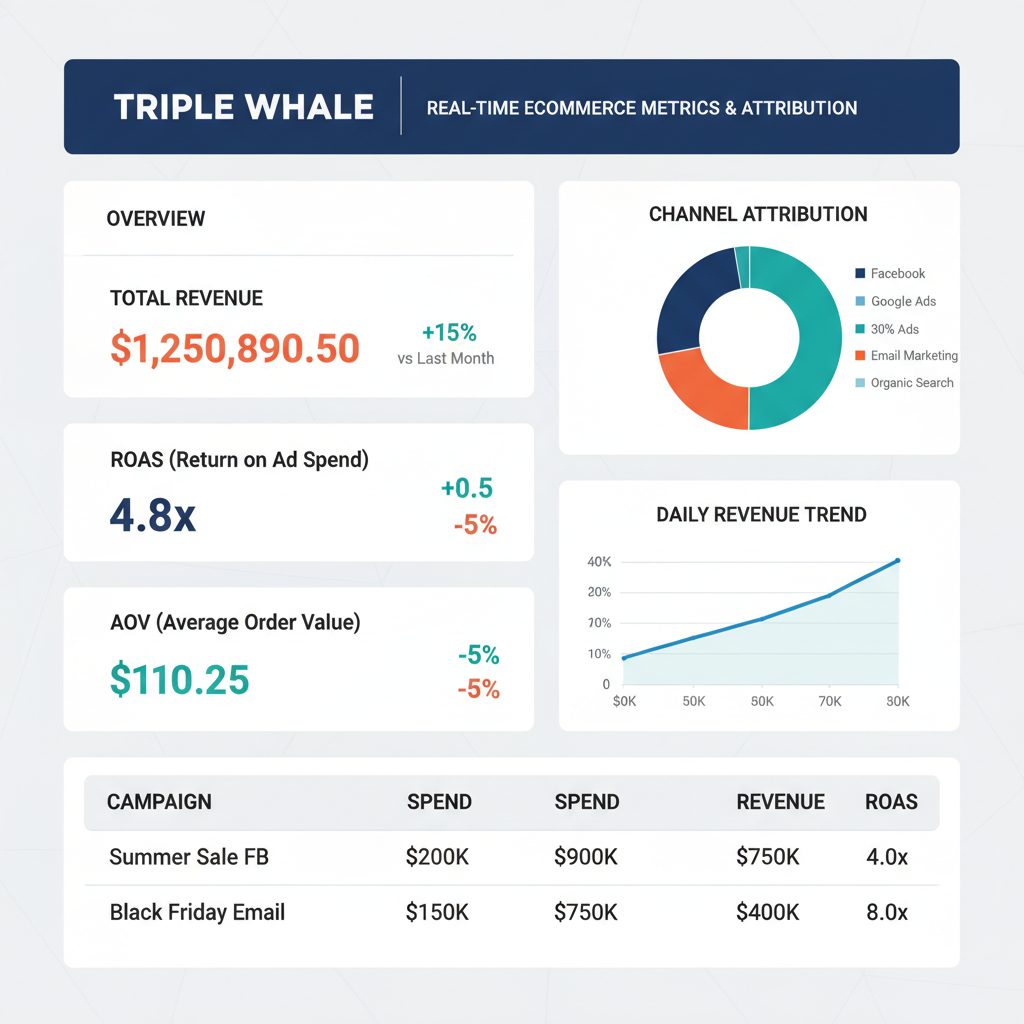
Real-time visibility into campaign performance across all connected platforms
Pricing Structure
Triple Whale offers tiered pricing based on your store's gross merchandise value (GMV):
- Growth Plan: Starting at $129/month
- Pro Plan: Starting at $199/month
- Enterprise Plan: Starting at $279/month
Pricing scales with your business size. High-GMV merchants may face significantly higher costs than entry-level pricing suggests.
Limitations to Consider
Performance with Large Datasets
Industry analysts report that Triple Whale's performance can degrade with large datasets. High-volume stores processing thousands of daily orders may experience slowdowns, making the platform better suited for small to mid-sized merchants.
Still Relies on Tracking
Despite using first-party data, Triple Whale still depends on pixel tracking and cookies. Cross-device attribution remains challenging, and users who block cookies or use privacy browsers disappear from the data entirely. This creates blind spots that grow as privacy adoption increases.
Ecommerce-Centric Design
The platform is built specifically for ecommerce—particularly Shopify. Businesses with significant offline revenue, B2B sales cycles, or non-ecommerce models will find limited utility.
BlueAlpha.ai: Deep Dive
Now let's examine BlueAlpha.ai and its statistical modeling approach.
Platform Overview
BlueAlpha.ai was developed by the team that built Tesla's marketing optimization systems. That pedigree shows in the platform's emphasis on rigorous methodology and actionable recommendations over dashboards and vanity metrics.
Where Triple Whale asks "what can we track?", BlueAlpha.ai asks "what can we prove actually works?"
Key Features
Bayesian Marketing Mix Modeling
BlueAlpha.ai's core technology uses Bayesian statistical methods to model the relationship between marketing spend and business outcomes. This approach provides probabilistic estimates of each channel's contribution—along with confidence intervals that tell you how certain those estimates are.
MIT Sloan research confirms that Bayesian methods excel at incorporating prior knowledge and handling uncertainty in marketing contexts. The result: more reliable optimization recommendations.
Privacy-Compliant by Design
Because MMM works with aggregate data rather than individual tracking, BlueAlpha.ai operates without cookies or pixels entirely. This makes it fully compliant with GDPR, CCPA, and upcoming privacy regulations—and immune to browser restrictions that degrade pixel-based solutions.
As privacy regulations tighten, this architectural advantage compounds. For context on why privacy-compliant measurement matters, our marketing effectiveness measurement guide explores the evolving landscape.
AI-Optimized Recommendations
The platform doesn't just report what happened—it recommends what to do next. Campaign-level budget recommendations, bid suggestions, and creative performance analysis help you act on insights without extensive manual analysis.
Incrementality Testing Integration
BlueAlpha.ai combines MMM with incrementality testing in a continuous learning loop. Experiments validate and calibrate model outputs, increasing confidence in recommendations over time. McKinsey's marketing research shows this hybrid approach delivers 30-40% more accurate ROI estimates than either method alone.
Cross-Channel Including Offline
Unlike pixel-based solutions limited to digital, MMM measures all marketing channels—TV, radio, out-of-home, direct mail, and sponsorships alongside digital. For brands with diverse media mixes, this comprehensive view proves essential.
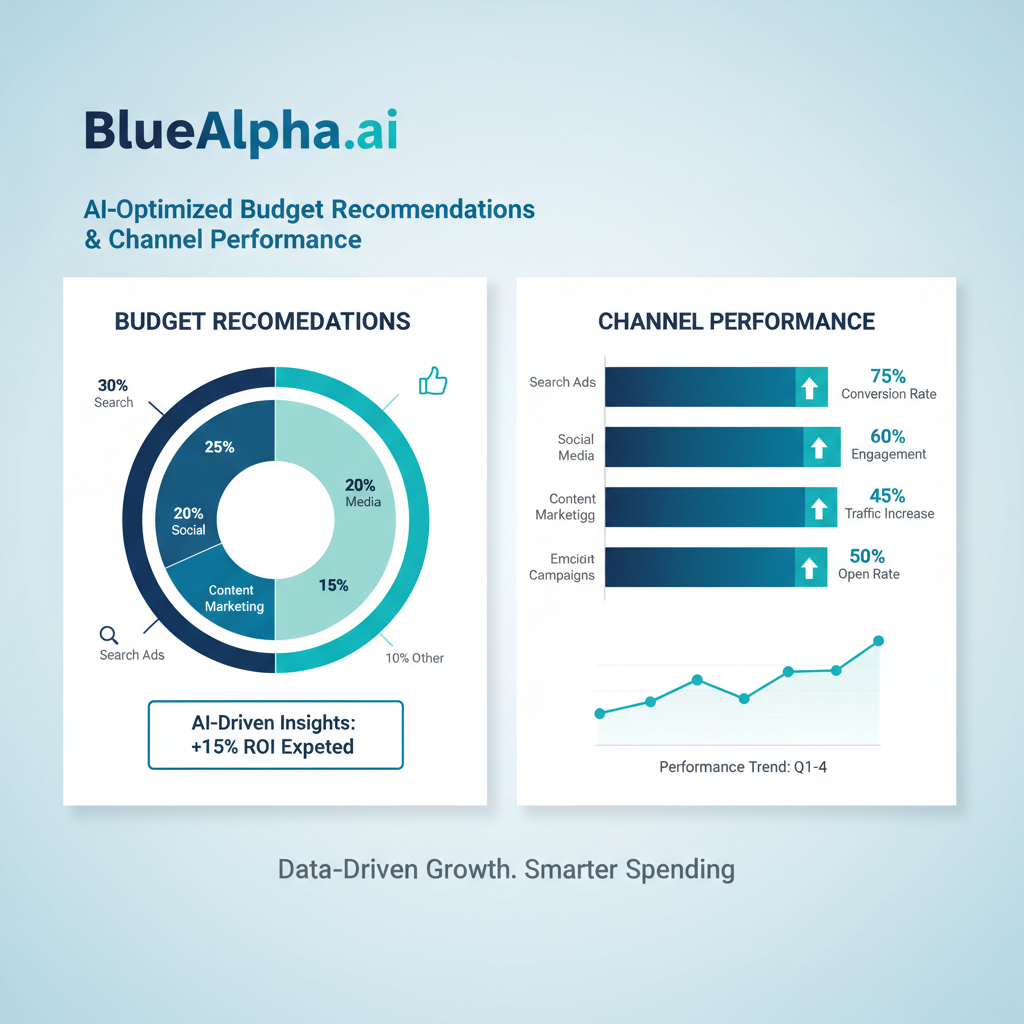
AI-driven recommendations turn measurement into actionable optimization
Ideal Use Cases
BlueAlpha.ai works best for:
- Brands spending $300K+ monthly across multiple channels
- Organizations measuring offline + digital together
- Teams needing board-level ROI proof beyond platform metrics
- Companies preparing for privacy changes proactively
- Marketers wanting optimization recommendations, not just reports
The platform appeals to organizations that need defensible, methodology-backed insights—not just another dashboard.
Head-to-Head Comparison
| Aspect | Triple Whale | BlueAlpha.ai |
|---|---|---|
| Primary Method | First-party pixel tracking | Marketing mix modeling |
| Target User | DTC ecommerce / Shopify | Multi-channel marketers |
| Time to Insights | Real-time | Days to weeks |
| Privacy Compliance | Moderate (first-party) | Full (no tracking) |
| Offline Measurement | Limited | Full support |
| Data Requirements | Website pixel + integrations | Historical spend + outcomes |
| Entry Pricing | $129/month | Custom pricing |
| Implementation | Self-service | Guided onboarding |
| Best For | Fast feedback loops | Strategic optimization |
Methodology: Tracking vs Modeling
This represents the fundamental difference between Triple Whale vs BlueAlpha.ai.
Triple Whale captures individual customer journeys through tracking. This enables real-time reporting and session-level attribution but remains vulnerable to privacy restrictions and tracking gaps.
BlueAlpha.ai analyzes patterns in aggregate data to measure marketing impact. This provides causal evidence of what actually works but requires more historical data to generate insights.
Neither approach is universally superior. Tracking delivers speed. Modeling delivers accuracy and privacy compliance. For marketing ROI analysis, the right choice depends on your specific context.
Scale and Complexity
Triple Whale serves primarily small to mid-sized ecommerce brands. The platform shines when you need simple, fast visibility into campaign performance. Performance limitations with large datasets constrain enterprise use cases.
BlueAlpha.ai targets organizations with more complex measurement needs—multiple channels, significant budgets, offline media, or sophisticated stakeholder requirements. The consultative approach ensures proper implementation but requires more upfront investment.
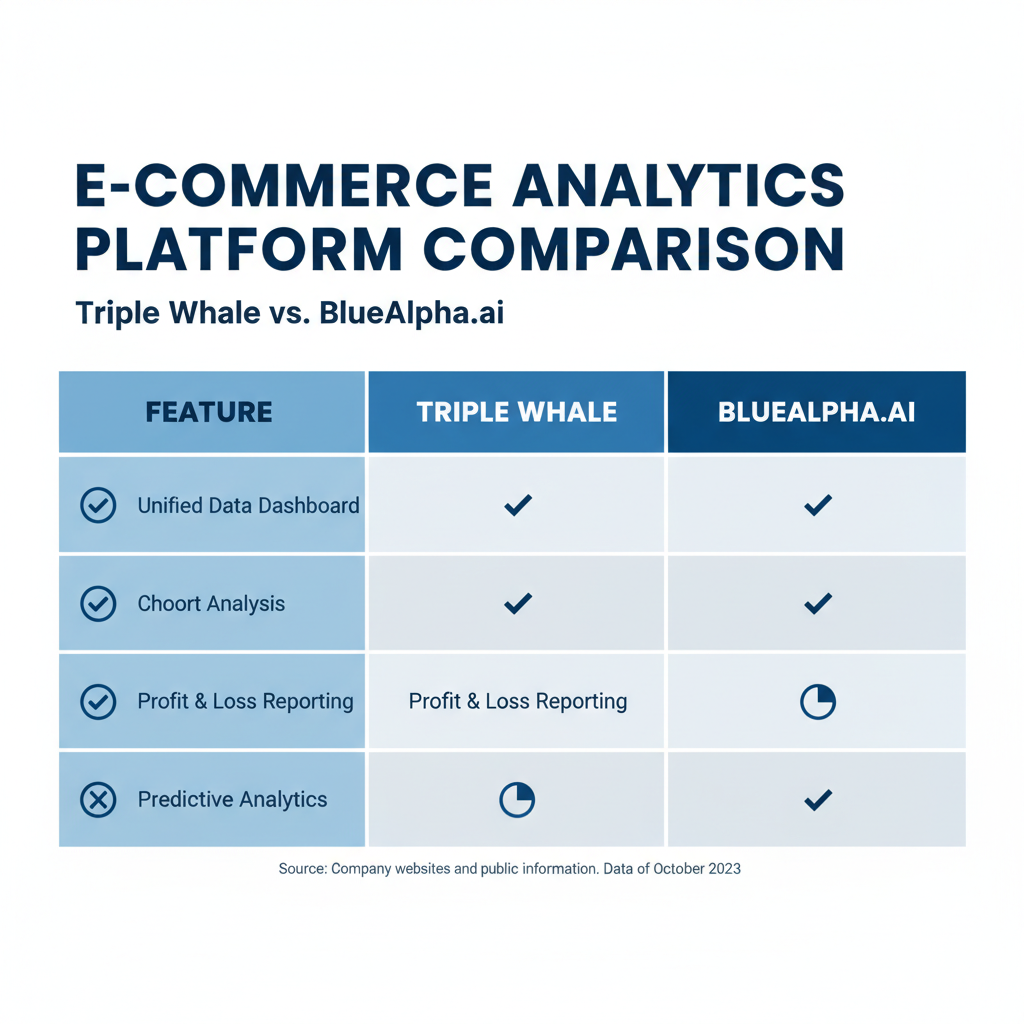
Feature-by-feature comparison reveals where each platform excels
Decision Framework: Which Platform Fits Your Needs?
Choose Triple Whale If:
- You're a Shopify merchant needing straightforward analytics integration
- Real-time feedback matters for your optimization process
- Your budget is under $300K monthly and primarily digital
- You prefer self-service tools with minimal onboarding
- Speed trumps precision in your decision-making
Triple Whale delivers immediate value for DTC brands wanting consolidated reporting and faster campaign iteration. If you're spending most of your budget on Meta and Google ads and need real-time ROAS visibility, it's a solid choice.
Choose BlueAlpha.ai If:
- You need to prove ROI to executives, investors, or board members
- Privacy compliance concerns you as regulations tighten
- Your media mix includes offline channels like TV, radio, or direct mail
- You're spending $300K+ monthly where optimization compounds significantly
- You want recommendations, not just reports
BlueAlpha.ai delivers defensible methodology and actionable optimization guidance. For organizations where measurement accuracy drives millions in allocation decisions, the investment pays for itself quickly.
Consider Both Platforms If:
Some organizations benefit from both approaches:
- Triple Whale for daily operational decisions and campaign monitoring
- BlueAlpha.ai for strategic planning and budget allocation
This combination provides real-time visibility alongside rigorous optimization—though it requires budget for both tools and processes to reconcile different data sources.
Before committing to either platform, assess your measurement readiness. Our MMM readiness checklist helps evaluate your current capabilities and data infrastructure.
Common Questions About Marketing Analytics Platforms
Understanding how these platforms handle specific scenarios helps clarify the right choice.
Cross-Channel Measurement
Triple Whale measures digital channels connected through its pixel and integrations. Cross-device attribution relies on probabilistic matching, which degrades as privacy restrictions increase. Offline channels like TV or radio aren't captured.
BlueAlpha.ai measures all channels—digital and offline—through statistical modeling. Because MMM doesn't track individuals, cross-device isn't an issue, and offline media integrates seamlessly.
Data Requirements
Triple Whale requires pixel installation and platform connections. You can start seeing data within days of setup. Historical data import is limited.
BlueAlpha.ai needs 12-24 months of historical spend and outcome data to build robust models. The upfront data gathering takes longer, but models improve continuously with more data.
For guidance on preparing your data infrastructure, our preparation tips cover requirements for both approaches.
Frequently Asked Questions
How does Triple Whale handle iOS 14 privacy changes?
Triple Whale mitigates iOS 14 impact through first-party pixel tracking, which isn't blocked by App Tracking Transparency. However, it still relies on cookies and client-side tracking, meaning users who block cookies or use privacy browsers remain invisible. The platform provides more visibility than Meta's native reporting but doesn't fully solve privacy-related data loss.
Is BlueAlpha.ai only for large enterprises?
No. While marketing mix modeling traditionally required large budgets, platforms like BlueAlpha.ai have made the methodology more accessible. Organizations spending $300K+ monthly across multiple channels typically see strong ROI from MMM investments. The threshold depends more on channel complexity than absolute spend.
Can I use both platforms together?
Yes. Some organizations use Triple Whale for real-time operational visibility while using BlueAlpha.ai for strategic optimization and budget allocation. This combines fast feedback with rigorous methodology—though it requires investment in both tools and reconciliation processes.
How long until I see results from each platform?
Triple Whale delivers insights almost immediately after pixel installation and platform connections—typically within 24-48 hours. BlueAlpha.ai requires initial model development using historical data, with first actionable insights typically available in 2-4 weeks depending on data readiness.
Which platform works better for D2C ecommerce?
Both platforms serve DTC brands effectively, but with different strengths. Triple Whale is purpose-built for ecommerce with native Shopify integration and real-time ROAS tracking. BlueAlpha.ai works well for DTC brands that have scaled beyond basic attribution needs and want optimization guidance. According to Forrester, growing DTC brands often start with tracking-based solutions and adopt MMM as they scale.
Conclusion
The Triple Whale vs BlueAlpha.ai decision ultimately reflects your measurement philosophy and business context.
Key takeaways:
- Triple Whale excels at real-time ecommerce analytics with native Shopify integration
- BlueAlpha.ai delivers privacy-compliant MMM with actionable optimization recommendations
- Pixel-based tracking provides speed; statistical modeling provides accuracy and privacy compliance
- Neither platform is universally "better"—context determines fit
- Both require solid data foundations to deliver value
For DTC brands wanting fast, consolidated reporting and campaign-level visibility, Triple Whale provides immediate value. For organizations needing defensible ROI proof, strategic optimization guidance, and future-proofed measurement, BlueAlpha.ai delivers the methodology and insights that drive better decisions.
The marketing measurement landscape will continue evolving as privacy regulations tighten and tracking degrades further. Whichever platform you choose, ensure it aligns with where measurement is heading—not just where it's been.
Ready to evaluate your measurement capabilities? Take our readiness quiz to assess your current state, or explore our preparation tips for building the data infrastructure both platforms require.
Stay in the loop
Get updates on new posts and resources.