Media Budget Optimization: Data-Driven Strategies That Actually Work
Master media budget optimization with proven frameworks for allocating ad spend across channels. Learn how to maximize ROI and eliminate wasted marketing dollars.
Most marketing budgets are bleeding money. Not through fraud or waste in the traditional sense—but through misallocation. Dollars flowing to underperforming channels while high-potential opportunities starve.
Media budget optimization solves this problem by using data to determine exactly where every marketing dollar should go. It's the difference between guessing and knowing. Between hoping for results and engineering them.
According to Nielsen research, the average marketing campaign achieves only 50% of its potential ROI due to suboptimal budget allocation. That means for every $100,000 you spend, you're leaving $50,000 in value on the table.
This guide breaks down exactly how to optimize your media budget—from foundational frameworks to advanced techniques that separate high-performing marketers from everyone else.
What is Media Budget Optimization?
Media budget optimization is the strategic process of distributing advertising spend across channels to maximize business outcomes. It answers a deceptively simple question: Where should each dollar go to generate the highest return?
But simple doesn't mean easy.
The challenge lies in the complexity of modern media landscapes. Your customers interact with your brand across dozens of touchpoints—social media, search, display, email, TV, podcasts, out-of-home. Each channel performs differently. Each has unique saturation points and diminishing returns curves.
Effective media budget optimization requires understanding:
- Which channels drive incremental conversions (not just attributed ones)
- How channels interact and influence each other
- Where you're hitting saturation points
- What external factors are affecting performance
- How to reallocate spend without disrupting momentum
The brands that master this don't just outperform competitors—they fundamentally change their cost structure. Research from McKinsey shows companies with advanced marketing measurement capabilities achieve 15-20% higher marketing ROI than their peers.
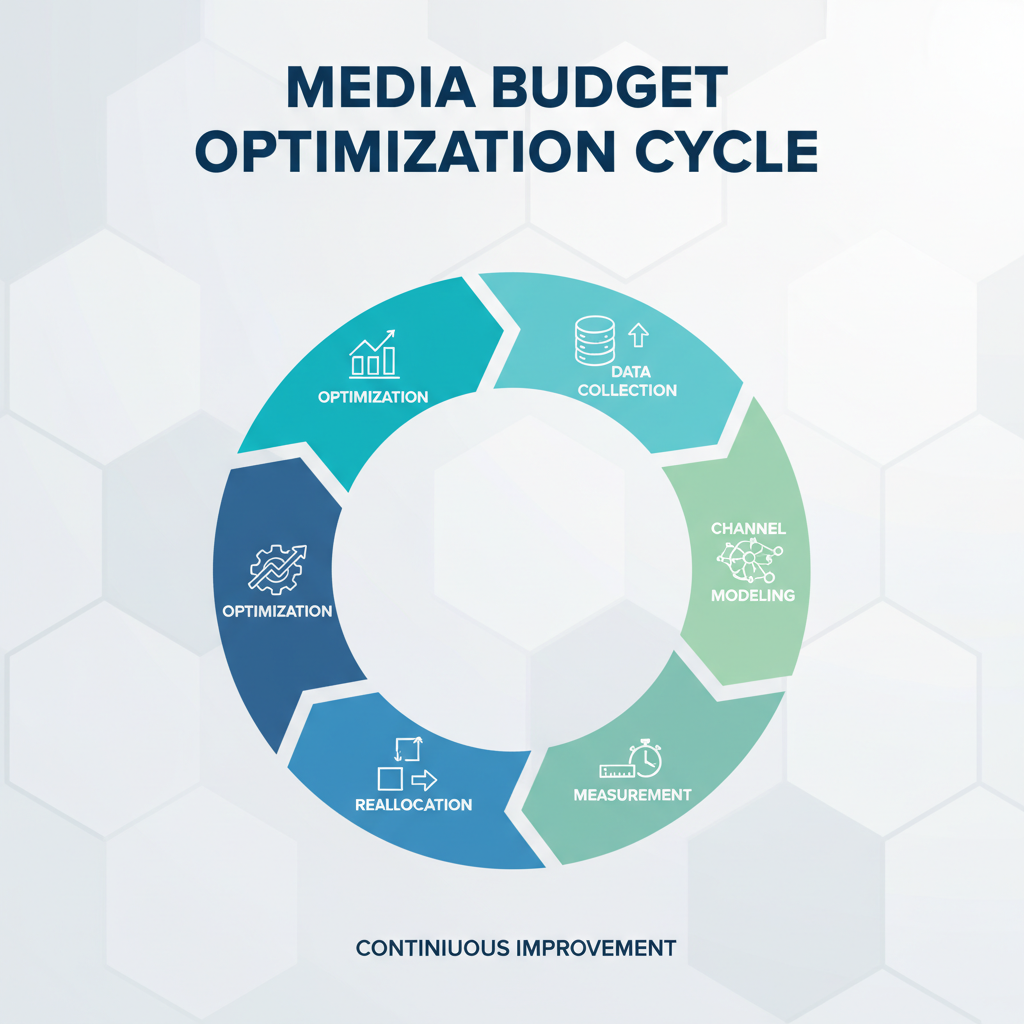
Effective budget optimization is a continuous cycle, not a one-time exercise
The Foundation: Understanding Channel Performance
Before you can optimize anything, you need accurate measurement. Most marketers think they have this—but they're usually measuring the wrong things.
Beyond Last-Click Attribution
Last-click attribution tells you which channel closed the deal. It doesn't tell you which channels created the opportunity in the first place.
Consider this scenario: A customer sees your TV ad, searches your brand on Google, clicks a retargeting display ad, then converts through an email campaign. Last-click gives email 100% credit. But would that conversion have happened without TV?
The answer matters more than you might think. Google's research indicates that multi-touch journeys involve an average of 20+ touchpoints before conversion in B2B contexts. Relying on last-click means you're systematically undervaluing awareness channels and overvaluing bottom-funnel activities.
Better approaches include:
- Multi-touch attribution models that distribute credit across touchpoints
- Incrementality testing using holdout groups to measure true lift
- Media mix modeling that analyzes aggregate data to determine channel contribution
Each approach has tradeoffs. Multi-touch attribution requires sophisticated tracking infrastructure. Incrementality testing requires sufficient budget to sacrifice some reach. Media mix modeling requires 12-18 months of historical data.
The most effective marketers use multiple approaches in combination—triangulating toward truth rather than relying on any single methodology.
Identifying Diminishing Returns
Every channel hits a point where additional spend generates progressively less return. Identify these saturation points, and you've found money to reallocate.
Signs you've hit diminishing returns:
- Frequency caps are maxed out
- CPM/CPC rising without conversion improvement
- Audience overlap increasing across campaigns
- Incremental conversion rate declining
The classic mistake is to keep scaling what's working without monitoring efficiency. A channel delivering 5:1 ROAS at $50K monthly might deliver only 2:1 ROAS at $150K. The math still looks positive—but those incremental dollars would perform better elsewhere.
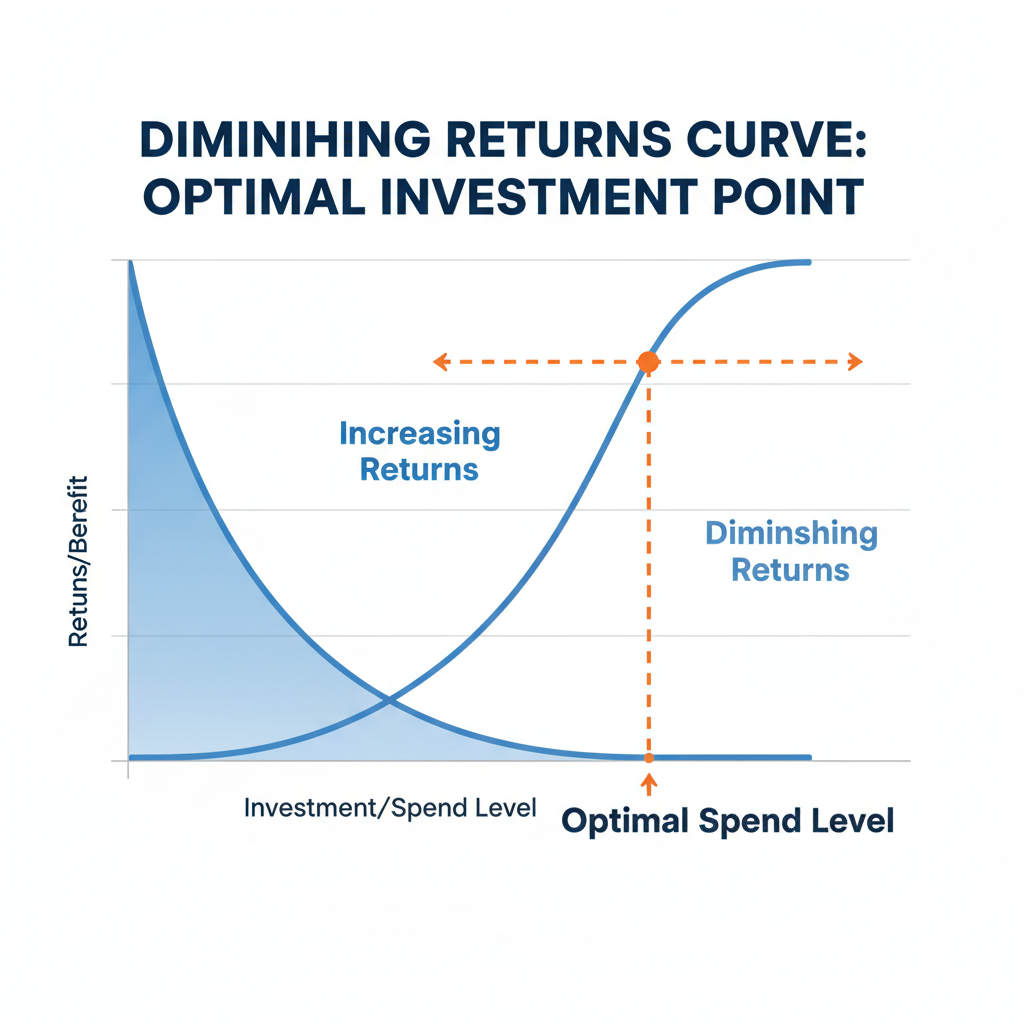
Every channel has an optimal spend level—finding it is the key to budget optimization
Core Strategies for Media Budget Optimization
1. Establish Baseline Performance Metrics
You can't improve what you don't measure. Start by documenting current performance across every channel.
Essential metrics to track:
| Metric | What It Tells You |
|---|---|
| ROAS | Revenue generated per dollar spent |
| Incremental ROAS | True lift from advertising |
| CAC | Cost to acquire a customer |
| Contribution Margin | Profit per channel after costs |
| Marginal ROI | Return on the next dollar spent |
Most marketing teams track ROAS religiously but ignore marginal ROI. That's backwards. ROAS tells you average performance. Marginal ROI tells you where to allocate your next dollar. And those are very different questions.
For detailed guidance on establishing baseline metrics, our MMM readiness checklist walks through exactly what data you need to collect.
2. Implement Cross-Channel Testing
Optimization requires experimentation. You need structured tests that isolate channel impact and reveal reallocation opportunities.
Effective testing approaches:
Geo-lift studies split markets into test and control groups, allowing you to measure true incremental impact of channel increases or decreases. Measured.com and similar platforms have made these accessible to mid-market companies.
Budget reallocation experiments shift spend between channels for defined periods, measuring impact on overall performance. Start small—10-15% shifts—to minimize risk while generating actionable data.
Holdout testing removes specific channels from certain audience segments to measure what happens without that touchpoint. This reveals which channels are actually driving conversions versus just getting attribution credit.
The key is controlled experimentation. Random budget changes based on gut feeling don't teach you anything. Structured tests with clear hypotheses and measurement frameworks do.
3. Model Channel Interactions
Channels don't operate in isolation. TV drives search volume. Social creates demand that converts through display. Email nurtures leads generated by paid media.
Understanding these interactions is crucial for optimization. Cutting a channel that appears underperforming might tank results across your entire funnel if it was secretly powering other channels.
Marketing mix modeling excels at capturing these dynamics. By analyzing aggregate data over time, MMM can identify how channels influence each other—something impossible with user-level attribution alone.
Common interaction patterns to look for:
- Halo effects: Brand advertising lifting performance of direct response channels
- Assist relationships: Content marketing generating leads that convert through paid search
- Cannibalization: Multiple channels competing for the same conversions
- Synergies: Channel combinations that perform better together than individually
According to Ipsos research, brands that optimize for cross-channel synergies achieve 20-30% better efficiency than those optimizing channels independently.
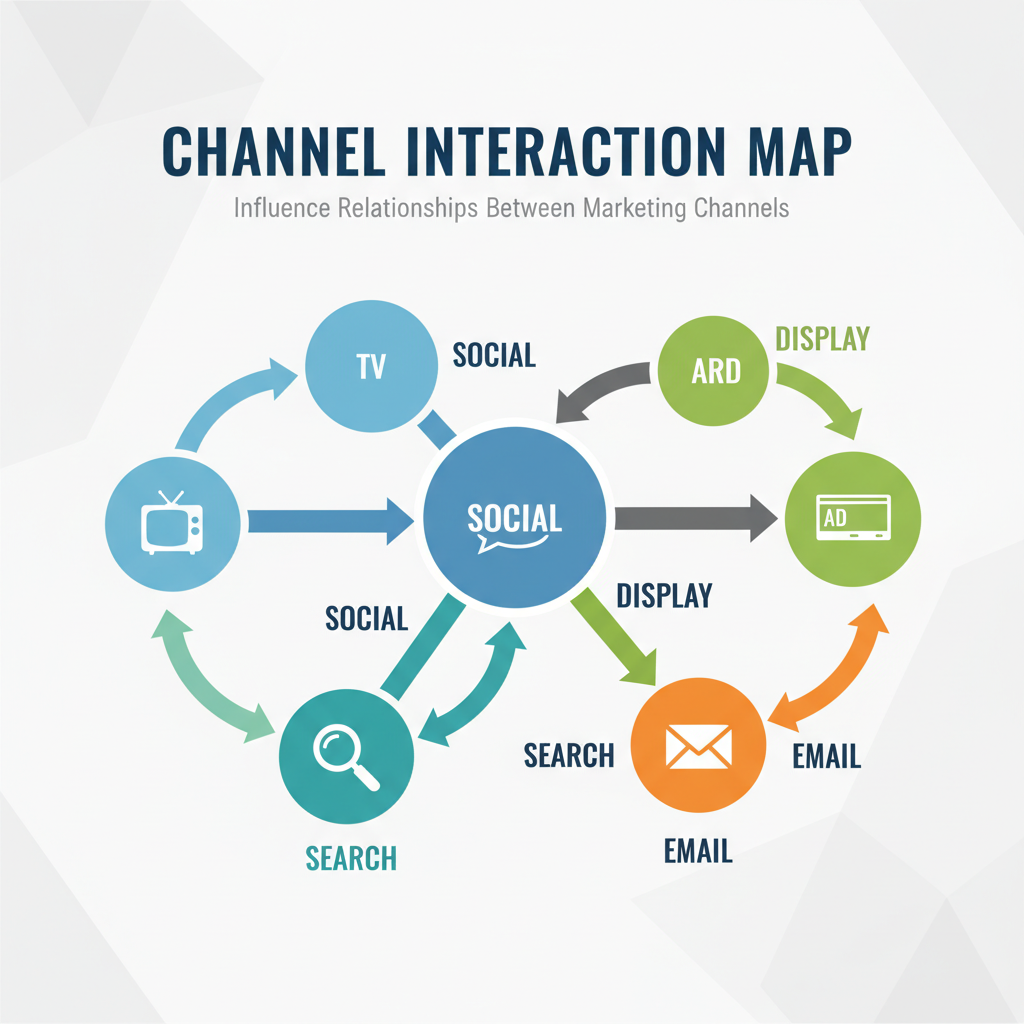
Understanding channel interactions prevents optimization mistakes that tank overall performance
4. Build Scenario Planning Capabilities
Static budgets fail in dynamic markets. You need the ability to model different scenarios and reallocate quickly based on performance.
Scenario planning should answer:
- What happens if we increase social by 20% and decrease display by 15%?
- How does performance change during peak vs. off-peak periods?
- What's the optimal budget mix at different total spend levels?
- Where should incremental budget go if we get additional funding?
Tools like Google's Meridian framework provide open-source options for budget optimization modeling. Commercial solutions from Measured, SegmentStream, and others offer more turnkey approaches with built-in forecasting.
The goal isn't perfect prediction—it's informed decision-making. Even directionally accurate scenarios dramatically improve allocation decisions compared to gut-feel approaches.
Advanced Optimization Techniques
Marginal ROI Analysis
Stop optimizing for average ROI. Start optimizing for marginal ROI—the return on your next dollar of spend.
Here's why this matters: A channel with 4:1 average ROAS might have only 1.5:1 marginal ROAS at your current spend level. Meanwhile, a channel with 2.5:1 average ROAS might have 3:1 marginal ROAS because you're underinvesting.
Optimizing for average ROAS keeps you stuck in local maxima. Optimizing for marginal ROAS finds the global maximum.
Calculating marginal ROI requires:
- Spending variation within channels over time
- Statistical modeling to isolate incremental impact
- Response curves showing how returns change at different spend levels
SegmentStream's analysis of cross-channel budget allocation found that marginal ROI-based optimization typically improves efficiency by 25-40% compared to traditional approaches.
Dynamic Budget Allocation
The optimal budget mix changes constantly. Seasonality, competitive dynamics, creative fatigue, and audience saturation all shift performance curves.
Dynamic allocation approaches:
- Weekly rebalancing based on performance signals
- Algorithmic optimization using machine learning models
- Pacing adjustments that shift spend based on real-time efficiency
- Trigger-based reallocation when performance crosses defined thresholds
The preparation tips on our site cover how to build the data infrastructure needed for dynamic optimization.
Most marketers resist dynamic allocation because it feels chaotic. But static annual budgets in a dynamic market guarantee suboptimal performance. The discipline comes from having clear decision rules—not from maintaining arbitrary spending patterns.
Privacy-First Measurement
Cookie deprecation and privacy regulations are disrupting traditional measurement. Forward-thinking marketers are adapting now.
Privacy-compatible optimization approaches:
- Aggregate data modeling that doesn't require user-level tracking
- First-party data strategies that reduce reliance on third-party cookies
- Probabilistic attribution using statistical methods
- Media mix modeling which has always been privacy-compliant by design
According to HubSpot's research, 75% of marketers rely on third-party data for campaign measurement—but that dependency is becoming a liability. Building privacy-first measurement capabilities now creates competitive advantage as the industry shifts.
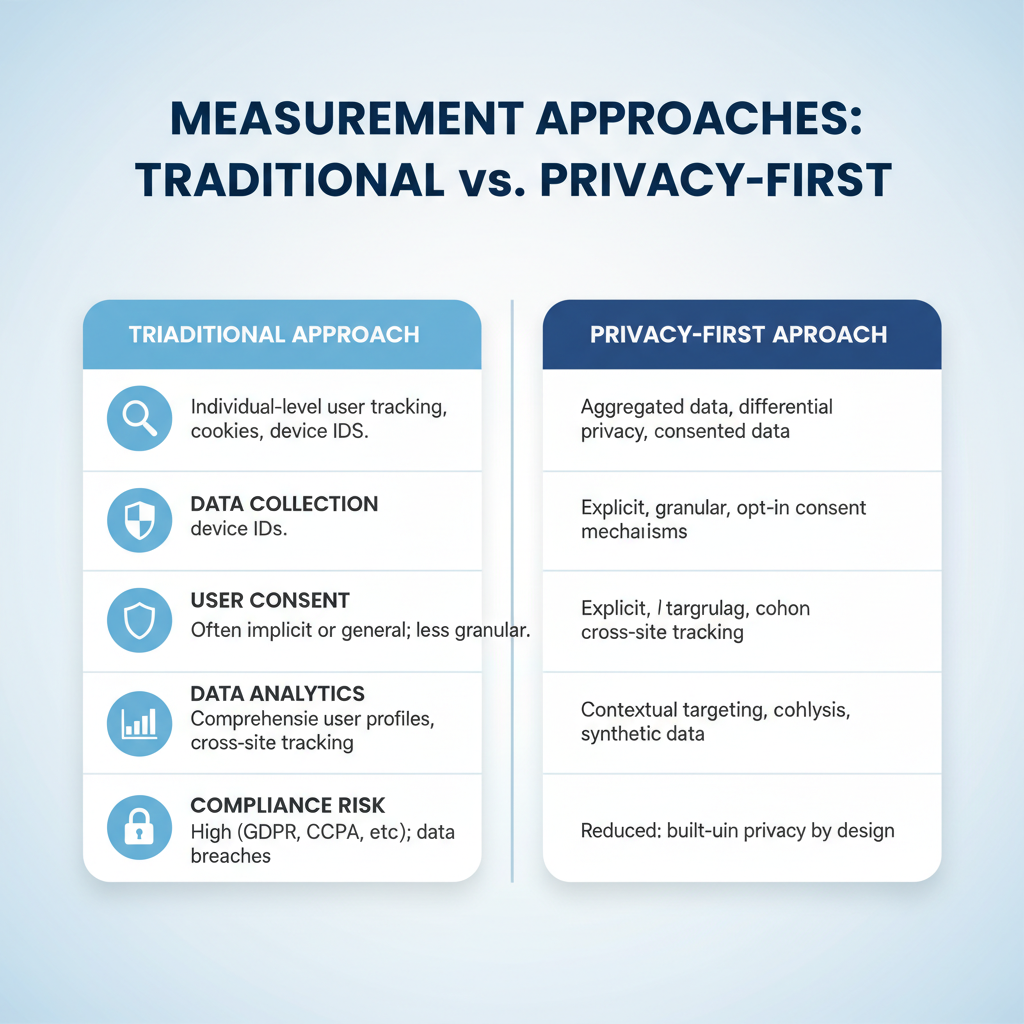
Privacy regulations are accelerating the shift toward aggregate measurement methods
Implementing Your Optimization Framework
Phase 1: Data Foundation (Weeks 1-4)
Before optimizing, ensure your data infrastructure supports accurate measurement.
Critical requirements:
- Daily-level spend data across all channels
- Consistent conversion tracking with unified definitions
- Historical data spanning at least 12 months
- External factors captured (seasonality, promotions, competitive activity)
- Centralized data warehouse or reporting system
Our MMM readiness checklist provides a comprehensive audit framework for this phase.
Phase 2: Baseline Analysis (Weeks 5-8)
Document current performance and identify initial optimization opportunities.
Activities:
- Calculate current ROAS and marginal ROI by channel
- Map channel interactions and customer journeys
- Identify channels hitting diminishing returns
- Spot underinvested opportunities
- Document performance variance and seasonality patterns
Phase 3: Test Design (Weeks 9-12)
Design controlled experiments to validate optimization hypotheses.
Key decisions:
- Which channels to test first (prioritize by opportunity size)
- Test duration (typically 4-8 weeks minimum for significance)
- Geographic or audience splits for holdout testing
- Success metrics and decision criteria
Phase 4: Execution and Learning (Ongoing)
Run tests, measure results, and iterate continuously.
Best practices:
- Start with smaller budget shifts (10-15%) to minimize risk
- Allow sufficient time for statistical significance
- Document learnings regardless of outcome
- Build institutional knowledge of channel dynamics
The marketers who win at optimization treat it as a continuous program, not a one-time project. They're constantly testing, learning, and refining their approach.
Common Mistakes to Avoid
Optimizing Channels in Isolation
Cutting a "low-performing" channel without understanding its impact on other channels is the most expensive mistake in media optimization. That awareness channel driving branded search might look inefficient—until you turn it off and watch your search performance crater.
Chasing Short-Term Metrics
Optimizing purely for immediate conversions often cannibalizes long-term performance. Brand building takes time. Attribution windows don't capture full customer lifetime value. Balance efficiency metrics with growth indicators.
Ignoring Creative and Messaging
Budget allocation matters—but so does what you're saying. A perfectly optimized media plan with terrible creative still underperforms. Ensure creative testing is part of your optimization program.
Over-Rotating on Recent Data
Last month's performance doesn't predict next month's optimal allocation. Seasonality, market conditions, and competitive dynamics constantly shift the landscape. Use longer time horizons and forward-looking indicators alongside recent performance data.
Frequently Asked Questions
How often should I reallocate my media budget?
Monthly reallocation is appropriate for most brands, with more frequent adjustments (weekly or bi-weekly) during high-stakes periods like product launches or peak seasons. The key is having clear decision criteria rather than arbitrary timing. Major strategic shifts should happen quarterly after comprehensive performance reviews.
What's the minimum budget needed for effective optimization?
Meaningful optimization typically requires at least $50,000 monthly in marketing spend across 3+ channels. Below this threshold, budget constraints limit your ability to test, and statistical significance becomes difficult to achieve. That said, even smaller budgets benefit from disciplined measurement and data-driven decision-making.
How do I handle channels that are hard to measure?
Difficult-to-measure channels like TV, podcasts, and out-of-home require different approaches. Media mix modeling handles these well by analyzing aggregate impact rather than user-level attribution. You can also use brand lift studies, search volume correlations, and geographic testing to estimate impact.
Should I optimize for ROAS or profit?
Profit. ROAS ignores margin differences between products, customer segments, and acquisition vs. retention scenarios. A 4:1 ROAS on a 20% margin product generates less value than 3:1 ROAS on a 50% margin product. Build contribution margin into your optimization models whenever possible.
How do I get stakeholder buy-in for budget reallocation?
Start with small tests that demonstrate clear results. Document the methodology and share learnings transparently. Frame recommendations in terms of business outcomes (revenue, profit) rather than marketing metrics. Build credibility through accurate forecasting—when your predictions come true, trust follows.
Conclusion
Media budget optimization isn't optional anymore. The brands that master it operate with fundamentally different economics than those relying on intuition and legacy allocation approaches.
Key takeaways:
- Measure incremental impact, not just attributed conversions
- Optimize for marginal ROI, not average performance
- Model channel interactions before reallocating spend
- Build scenario planning capabilities for dynamic markets
- Treat optimization as a continuous program, not a project
The gap between optimized and unoptimized marketing performance is widening. As measurement capabilities advance and competition intensifies, the cost of suboptimal allocation grows every year.
Start where you are. Use the MMM readiness checklist to assess your current capabilities. Identify the biggest gaps. Build toward data-driven allocation one step at a time.
The marketers who figure this out first don't just perform better—they make it harder for everyone else to compete.
Ready to optimize your media budget? Take our readiness quiz to assess your current measurement capabilities, or explore our preparation tips for guidance on building the data infrastructure needed for effective optimization.
Stay in the loop
Get updates on new posts and resources.