Meta Robyn: Complete Guide to Open-Source Marketing Mix Modeling
Master Meta Robyn for marketing mix modeling. Learn setup, features, optimization techniques, and when to use this open-source MMM tool.

Privacy changes killed traditional attribution. Cookies are dying. iOS tracking? Essentially dead. Marketers suddenly need alternative ways to measure what's actually working.
Enter Meta Robyn—an open-source marketing mix modeling package that's rapidly becoming the go-to solution for data teams tired of black-box attribution tools. Developed by Meta Marketing Science, Robyn automates the traditionally complex MMM process while making advanced statistical modeling accessible to teams without PhD-level econometricians on staff.
According to research from Marketing Evolution, companies using marketing mix modeling see 15-20% improvement in marketing ROI compared to those relying solely on digital attribution. Robyn makes this possible without enterprise-level budgets.
This guide breaks down everything you need to know about Meta Robyn—from technical architecture to practical implementation—so you can determine if it's right for your organization.
What is Meta Robyn?
Meta Robyn is an AI/ML-powered marketing mix modeling package developed by Meta's Marketing Science team. Released as open-source software under the MIT license, it automates the complex process of building, calibrating, and deploying marketing mix models.
The tool addresses a fundamental problem: traditional MMM required months of manual work from specialized statisticians. Robyn condenses this into a more accessible process through automation while maintaining statistical rigor. According to Gartner research, only 54% of marketing decisions are influenced by analytics—a gap Robyn helps close.
At its core, Robyn answers the questions that keep marketing leaders awake at night:
- Which channels actually drive incremental business results?
- Where are we over or under-investing?
- How do different channels interact with each other?
- What's the optimal budget allocation across our media mix?
Unlike user-level attribution that tracks individual clicks and conversions, Robyn works with aggregate data—making it inherently privacy-compliant. No cookies required. No PII needed. Just historical spending and outcome data.
The package is available in both R and Python, with the R version being more mature (since 2019) and the Python version released in late 2024 for broader accessibility. You can find the official documentation on Robyn's GitHub repository.
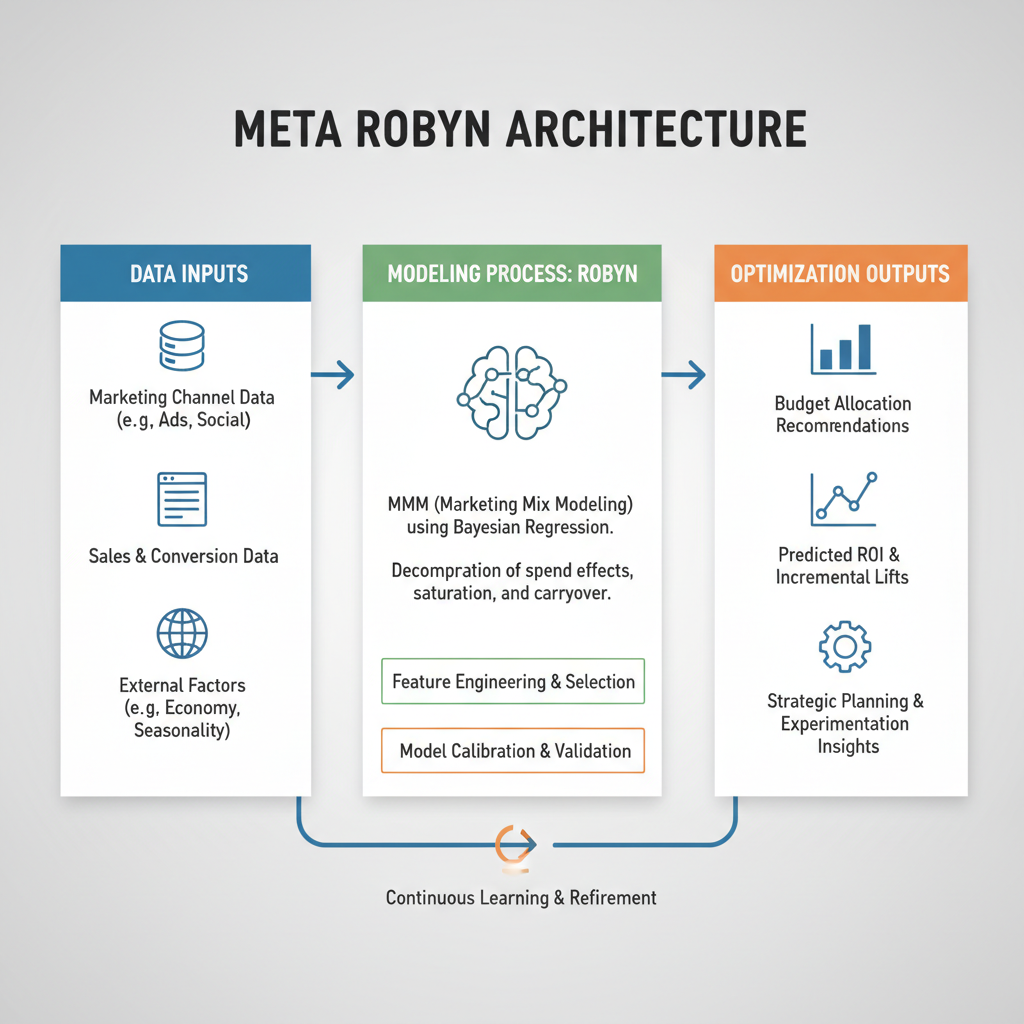
Robyn automates the traditionally manual MMM process through integrated AI/ML components
Key Features of Meta Robyn
Automated Hyperparameter Optimization
Traditional MMM requires analysts to manually tune dozens of parameters through trial and error. Robyn eliminates this through Nevergrad, Meta's open-source optimization library.
The system uses multi-objective evolutionary algorithms to simultaneously optimize multiple goals—model fit, business constraints, and prediction accuracy. This process explores thousands of potential model configurations automatically, finding optimal combinations that human analysts might never discover.
The result? Models that better explain historical data while respecting real-world constraints on how marketing actually works. This automation represents a significant advancement in modern marketing measurement.
Ridge Regression for Robust Modeling
Marketing data is messy. Channels correlate with each other. Seasonal patterns overlap with campaign timing. Multicollinearity—when predictor variables are correlated—plagues almost every marketing dataset.
Robyn addresses this through Ridge Regression, a regularization technique that prevents individual variables from dominating models inappropriately. This produces more stable, interpretable results even when your media variables move together.
For marketers, this means more trustworthy insights about individual channel performance—not just aggregate predictions that hide which channels are actually driving results. Understanding true marketing ROI requires this level of statistical rigor.
Time-Series Decomposition with Prophet
Understanding marketing impact requires separating signal from noise. Robyn integrates Meta's Prophet library to automatically decompose your data into:
- Trend components: Long-term changes in baseline performance
- Seasonal patterns: Weekly, monthly, and annual cycles
- Holiday effects: Impact of specific events and promotions
- Residual variation: What's left after accounting for predictable patterns
This decomposition is crucial for accurate marketing effectiveness measurement. Without it, you might attribute seasonal sales bumps to marketing campaigns that just happened to run during peak periods.
Adstock and Saturation Modeling
Marketing doesn't work instantly. TV ads create awareness that converts weeks later. Brand campaigns build equity over months. Robyn models these carryover effects through geometric and Weibull adstock transformations.
Similarly, channels hit diminishing returns at high spending levels. Robyn captures these saturation effects through Hill functions, showing exactly where additional spending stops generating proportional returns.
These features enable the kind of media budget optimization that separates sophisticated marketers from those guessing at allocation decisions.
Built-in Budget Allocator
Knowing how channels performed historically is useful. Knowing how to allocate next quarter's budget is actionable.
Robyn includes a gradient-based constrained optimization engine that recommends optimal budget distributions. Feed it your total budget and business constraints, and it calculates the allocation that maximizes predicted outcomes.
This shifts conversation from "what happened" to "what should we do"—exactly what marketing leaders need from their analytics investments. The budget allocator addresses the core challenge of funnel-stage budget allocation that most organizations struggle with.
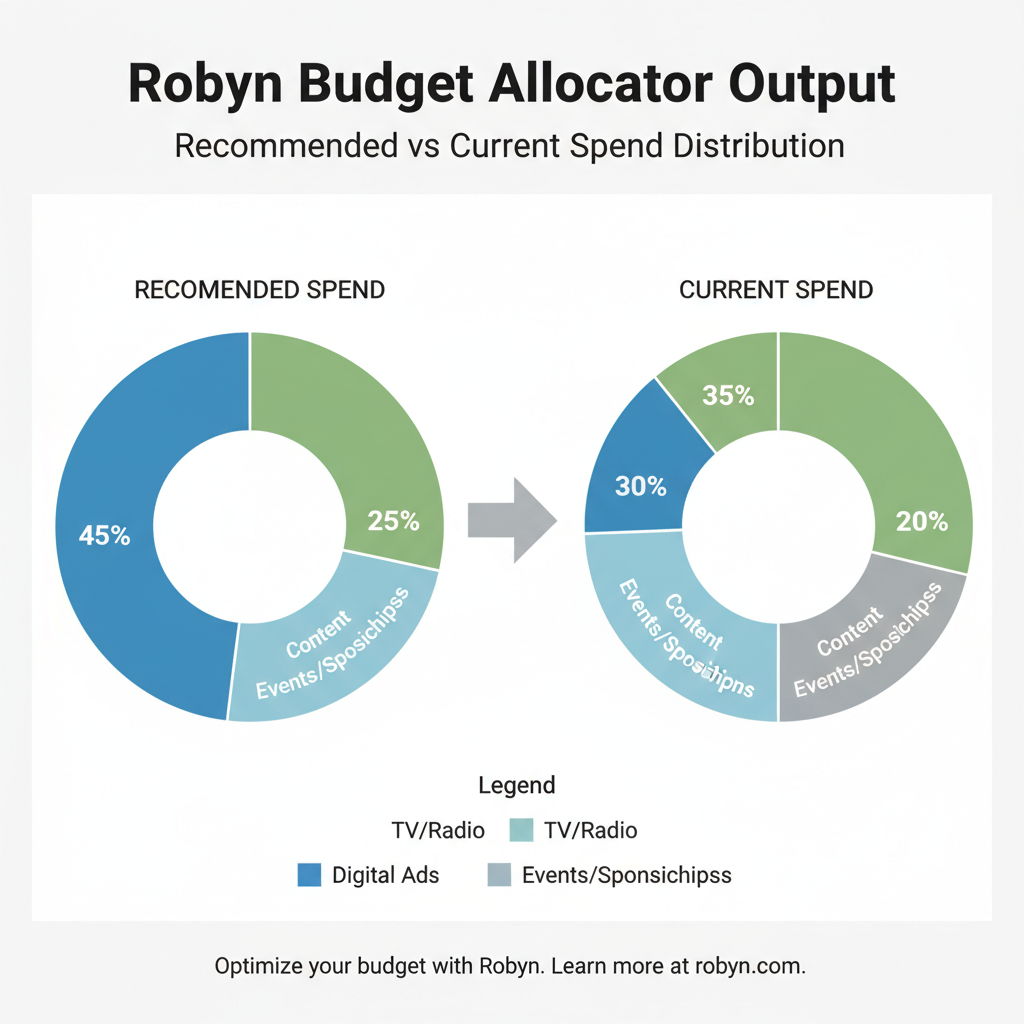
Robyn's allocator translates model insights into actionable budget recommendations
How Meta Robyn Works: Technical Deep Dive
Data Requirements
Before running Robyn, you need structured historical data. The minimum requirements include:
Dependent variable (KPI):
- Sales revenue, conversions, or other business outcomes
- Minimum 104 weeks (2 years) recommended for statistical reliability
- Weekly or daily granularity
Marketing variables:
- Spend data for each channel (impressions work too)
- Consistent granularity matching your KPI data
- Clean, complete time series without gaps
Context variables (recommended):
- Promotional calendars and pricing data
- Competitive activity indicators
- Economic indicators relevant to your business
- Distribution or availability metrics
The MMM readiness checklist provides a comprehensive audit framework for evaluating your data infrastructure.
The Modeling Process
Robyn's workflow follows a systematic process that reflects best practices established by organizations like Nielsen and other measurement leaders:
Step 1: Data Preprocessing The system validates inputs, handles missing values, and standardizes variables for modeling. Prophet runs first to decompose trends and seasonality.
Step 2: Feature Engineering Robyn applies adstock transformations (modeling carryover effects) and saturation transformations (modeling diminishing returns) to each media variable. The specific parameters for these transformations become part of the optimization process.
Step 3: Hyperparameter Optimization Nevergrad's evolutionary algorithms explore the parameter space, testing thousands of combinations of adstock decay rates, saturation curves, and regression coefficients. Multi-objective optimization balances model fit (NRMSE), decomposition share (business realism), and other metrics simultaneously.
Step 4: Model Selection Robyn generates a Pareto frontier of optimal models—solutions where improving one objective requires sacrificing another. Analysts select from these candidates based on business knowledge and validation criteria.
Step 5: Calibration and Validation Optional but recommended: calibrate model results against incrementality experiments or other ground-truth measurements. This step dramatically improves model reliability.
Step 6: Output Generation Final outputs include channel contribution decompositions, ROI curves, response curves showing diminishing returns, and budget optimization recommendations.
Technical Architecture
Robyn's architecture reflects lessons learned from building MMM at massive scale:
| Component | Technology | Purpose |
|---|---|---|
| Time-series decomposition | Prophet | Trend and seasonality extraction |
| Optimization | Nevergrad | Hyperparameter tuning |
| Regression | Ridge | Model fitting with regularization |
| Visualization | ggplot2/matplotlib | Output interpretation |
| Budget optimization | Gradient-based solver | Allocation recommendations |
The modular design means individual components can be upgraded as better algorithms emerge. It also means you can inspect exactly what's happening at each step—no black boxes.
Getting Started with Meta Robyn
Installation Requirements
For R users (recommended for production use):
# Install from CRAN
install.packages("Robyn")

# Or from GitHub for latest version
remotes::install_github("facebookexperimental/Robyn/R")

# Required dependencies
install.packages(c("reticulate", "prophet", "nloptr"))
Robyn also requires Python for the Nevergrad optimization engine. The reticulate package handles R-Python communication automatically.
For Python users (newer, in beta):
pip install robyn
The Python version, released in December 2024, provides equivalent functionality with a more familiar syntax for data science teams already working in Python.
Data Preparation Best Practices
Data quality determines model quality. Follow these guidelines:
Spend data accuracy: Ensure media costs reflect actual investment timing. If your accounting system records invoices differently than when ads ran, align to exposure timing.
Consistent definitions: Your conversion metric must mean the same thing throughout the time series. Definition changes mid-stream create artificial discontinuities.
Outlier handling: Major disruptions (like COVID-19) may require exclusion or dummy variables. Robyn includes features for handling such events, but they require thoughtful implementation.
Variable completeness: Missing data points cause problems. Either fill gaps systematically or truncate your analysis to clean periods.
For comprehensive guidance on data preparation, our preparation tips cover everything from data collection to quality validation.
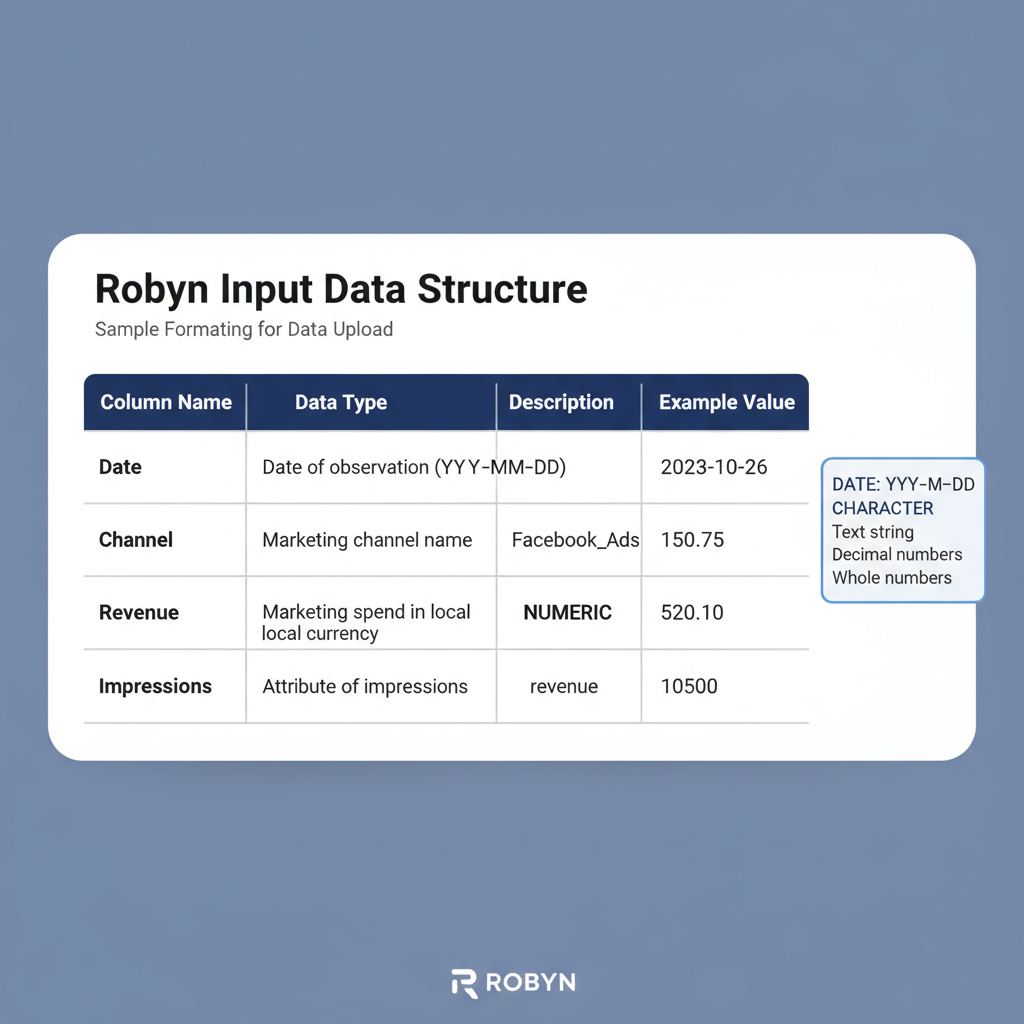
Properly structured data is the foundation of reliable Robyn models
Practical Implementation Considerations
When Robyn Works Well
Meta Robyn excels in specific scenarios:
Rich historical data: Organizations with 2+ years of granular media data get the most value. More data enables more reliable decomposition and response curve estimation.
Significant media investment: Companies spending $1M+ annually across multiple channels have enough variation to detect channel-level effects. Smaller budgets produce noisier, less actionable results.
Technical resources: Teams with data engineers or analysts comfortable with R/Python can implement and maintain Robyn effectively. It's open-source software, not a turnkey product.
Experimentation culture: Organizations running incrementality tests can calibrate Robyn models against ground-truth measurements, dramatically improving reliability. Research from Harvard Business Review confirms that experimentation-driven organizations significantly outperform peers.
Common Challenges and Limitations
Robyn isn't magic. Understanding its limitations helps set appropriate expectations:
Overparameterization risk: With many channels and transformations, models can become overfit—explaining historical data perfectly while providing poor forward guidance. Careful validation is essential.
Model instability: Small changes to input data can sometimes produce meaningfully different results. Running multiple iterations and examining result consistency helps identify this issue.
Technical expertise required: Despite automation, interpreting outputs and validating results requires statistical literacy. Bad models can produce confident-looking but wrong recommendations.
No real-time optimization: Robyn operates on historical data for strategic planning. It doesn't provide in-flight campaign optimization or real-time bidding signals.
Calibration challenges: Without incrementality experiments for calibration, models may systematically over or undervalue certain channels. The Marketing Accountability Standards Board recommends calibrating MMM results against experimental data whenever possible.
Calibration Best Practices
Uncalibrated models are dangerous. They might look reasonable while being systematically wrong.
Incrementality testing: Run controlled experiments that measure true channel lift. Geo-based tests, holdout experiments, and platform-provided lift studies all work.
External validation: Compare model-predicted outcomes against actual results during holdout periods. Significant discrepancies indicate model problems.
Business logic checks: Model outputs should align with business reality. If the model shows your largest channel has negative ROI, something's wrong.
Cross-validation: Use time-based splits to test whether models trained on early data predict later performance accurately.
Meta Robyn vs. Alternative Approaches
Open-Source Alternatives
Several open-source options compete with Robyn:
Google's Meridian (successor to LightweightMMM) uses Bayesian methods rather than Ridge regression. It provides uncertainty quantification that Robyn lacks but requires more computational resources and statistical expertise.
PyMC-Marketing offers fully Bayesian MMM with maximum flexibility for custom model specifications. Best for teams with strong statistical backgrounds who need non-standard approaches.
Orbit by Uber provides Bayesian time-series forecasting that can be adapted for MMM use cases with additional development work.
Each tool makes different tradeoffs between automation and flexibility, ease of use and statistical rigor. Robyn's strength is the automation that makes MMM accessible to teams without dedicated econometricians.
Commercial Platforms
Enterprise MMM platforms offer advantages over open-source tools:
- Managed infrastructure: No setup, maintenance, or scaling concerns
- Pre-built integrations: Automatic data connections with major ad platforms
- Validation frameworks: Built-in calibration against industry benchmarks
- Analyst support: Expert guidance on interpretation and optimization
- Faster time-to-value: Weeks instead of months to actionable insights
The tradeoff is cost and customization flexibility. Open-source gives you complete control. Commercial platforms give you speed and support. For a detailed breakdown of your options, see our comprehensive MMM comparison guide.
For organizations evaluating their options, understanding which approach fits your specific situation matters more than finding the "best" tool.
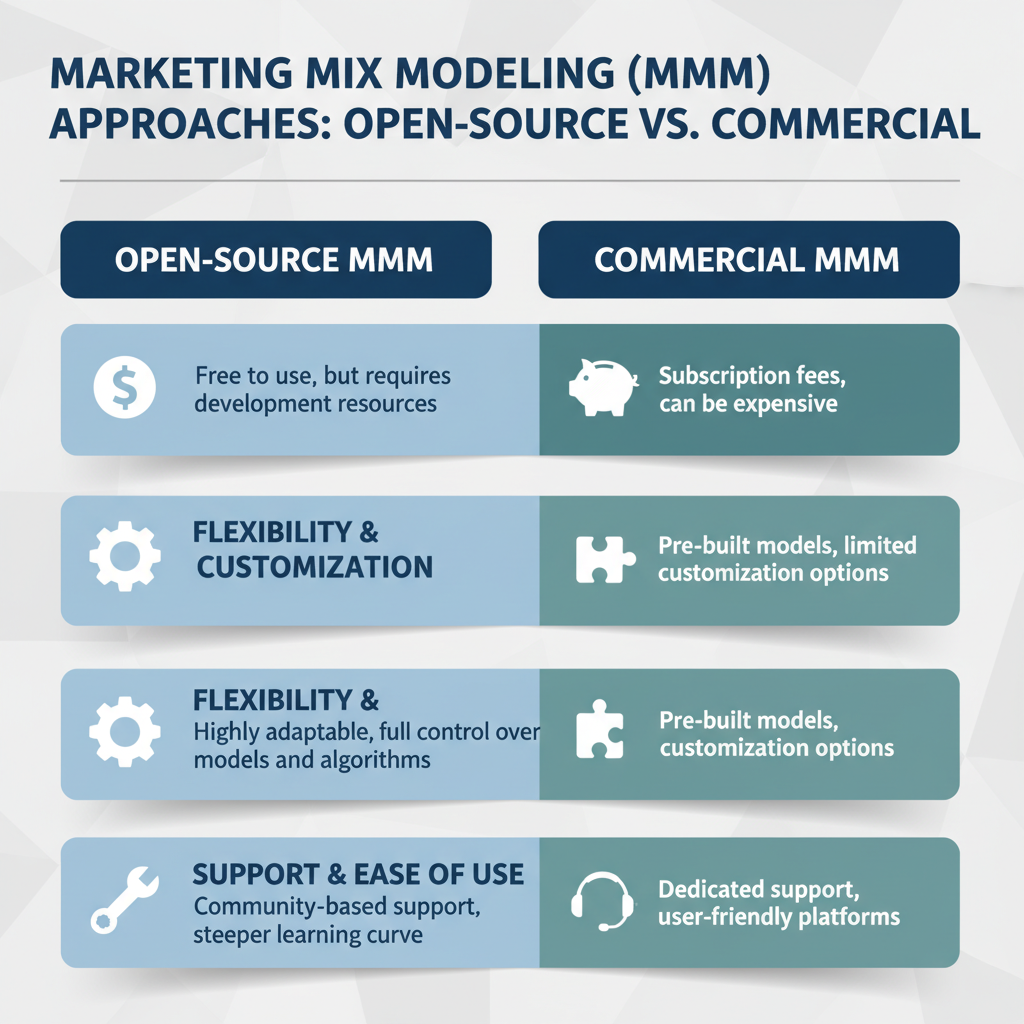
The right MMM approach depends on your team's capabilities and business requirements
Optimizing Your Robyn Implementation
Model Validation Framework
Don't trust any model output without validation:
Statistical validation:
- Check NRMSE (Normalized Root Mean Square Error) for fit quality
- Examine decomposition shares for business realism
- Review confidence intervals where available
Business validation:
- Do ROI rankings match directional expectations?
- Are response curves shape reasonable for each channel?
- Do saturation points align with known budget constraints?
Predictive validation:
- Hold out recent periods and test prediction accuracy
- Compare forecasted vs. actual performance over time
- Monitor for model drift requiring recalibration
Iterating Toward Better Models
Initial Robyn runs rarely produce perfect results. Plan for iteration:
Phase 1: Run baseline models with default settings to understand data characteristics and identify obvious issues.
Phase 2: Adjust constraints based on business knowledge. If you know a channel has positive ROI, constrain the model accordingly.
Phase 3: Add calibration data from experiments to anchor results in measured reality.
Phase 4: Test sensitivity by varying inputs and observing output stability. Robust models produce consistent insights despite input variation.
Phase 5: Implement in production with regular refresh cycles—quarterly model updates work well for most organizations.
Integration with Marketing Operations
Models that sit in notebooks don't drive decisions. Successful implementations integrate Robyn outputs into operational workflows:
Planning integration: Feed budget recommendations into annual planning processes. Strategic budget allocation should reference MMM insights.
Reporting integration: Include MMM-based metrics alongside platform-reported attribution. Stakeholders need both views.
Testing integration: Use model predictions to design better experiments. Test channels where models suggest opportunity.
Frequently Asked Questions
How much data does Meta Robyn require?
Robyn recommends minimum 104 weeks (2 years) of historical data for reliable results. More data generally produces better models, with 3+ years being ideal. However, older data becomes less relevant as markets change—balance historical depth against recency.
Can Robyn handle both digital and traditional media?
Yes. Robyn models any channel with consistent spend and outcome data. TV, radio, OOH, print, digital display, social, search—all work within the framework. This cross-channel capability is precisely why marketing mix modeling has regained importance as digital attribution faces privacy headwinds.
How often should I refresh Robyn models?
Quarterly updates work well for most organizations. More frequent updates don't dramatically improve accuracy and create operational overhead. Major market changes (new competitors, significant budget shifts, business model changes) warrant ad-hoc refreshes.
Is Meta Robyn really free?
Yes. Robyn is MIT-licensed open-source software. You can use it commercially without licensing fees. The costs are internal: data engineering, analyst time, infrastructure, and ongoing maintenance.
How does Robyn compare to Google Meridian?
Robyn uses frequentist methods (Ridge regression) while Meridian uses Bayesian approaches. Meridian provides uncertainty quantification; Robyn emphasizes automation. Both are legitimate approaches—choice depends on team capabilities and specific requirements.
Can non-technical marketers use Robyn?
Not directly. Robyn requires coding proficiency (R or Python) and statistical literacy for implementation and interpretation. Marketers benefit most from Robyn when partnered with technical analysts who can translate results into strategic recommendations.
Conclusion
Meta Robyn democratizes marketing mix modeling in ways that weren't possible five years ago. What once required specialized consulting firms and six-figure projects now runs on your laptop with open-source code.
Key takeaways:
- Robyn automates traditional MMM through AI/ML-powered optimization
- Privacy-compliant measurement without user-level tracking
- Built-in budget allocation recommendations translate analysis into action
- Significant technical requirements—not a plug-and-play solution
- Calibration against experiments dramatically improves reliability
The tool isn't perfect. Overparameterization, model instability, and validation complexity remain real challenges. But for organizations with technical resources and quality data, Robyn provides a powerful foundation for privacy-first marketing measurement.
Start by assessing your readiness. Use the MMM readiness checklist to evaluate your data infrastructure. Identify gaps. Build the foundation first.
For organizations that need results faster—or lack internal data science resources—managed solutions offer an alternative path. Platforms like BlueAlpha AI provide the benefits of sophisticated marketing mix modeling without the technical overhead of building and maintaining open-source implementations. Their approach combines the analytical rigor of advanced MMM with the practical support teams need to translate insights into improved marketing performance.
Whether you choose Robyn, a commercial platform, or some combination, the important thing is starting. The marketers measuring effectively while others guess will compound their advantages every quarter. Don't get left behind.
Ready to evaluate your MMM readiness? Take our free assessment quiz to understand where you stand, or explore our preparation guide for practical next steps.
Stay in the loop
Get updates on new posts and resources.