Google Meridian: Complete Guide to Google's Open-Source MMM
Master Google Meridian for marketing mix modeling. Learn setup, features, data requirements, and how to optimize your marketing budget with this open-source MMM.
Google just made enterprise-grade marketing measurement free. In January 2025, they released Google Meridian—an open-source marketing mix model that rivals tools costing six figures annually.
For marketers struggling to understand which channels actually drive results, this changes everything. No more black-box vendors. No more guessing. Just transparent, customizable, data-driven insights into your marketing effectiveness.
But here's the catch: Meridian isn't plug-and-play. It requires technical expertise, clean data, and careful implementation. This guide breaks down everything you need to know—from core concepts to practical implementation steps.
What is Google Meridian?
Google Meridian is an open-source marketing mix model built on Bayesian causal inference. Unlike traditional MMMs that rely solely on historical correlations, Meridian blends prior knowledge with observed data to estimate the true incremental impact of your marketing activities.
The framework analyzes how different marketing channels—TV, digital, search, social, radio—contribute to business outcomes like sales, conversions, or website visits. It accounts for factors that traditional attribution misses: delayed effects, diminishing returns, and cross-channel interactions.
According to Google's announcement, Meridian represents their latest thinking on marketing measurement—developed over years of internal research and real-world testing with major advertisers.
Why Google Built Meridian
Cookie deprecation broke traditional attribution. Privacy regulations made user-level tracking increasingly unreliable. Marketers needed an alternative that didn't depend on tracking individual users across the web.
Marketing mix modeling fills this gap. It uses aggregate data—total spend and total outcomes—to determine channel effectiveness without tracking any individual person.
Google already offered LightweightMMM as a simpler solution. But Meridian goes further:
- Bayesian methodology produces probability distributions, not just point estimates
- Reach and frequency integration for video campaigns reveals diminishing returns
- Search query volume data improves measurement of paid search contributions
- Incrementality calibration lets you validate model outputs against experiments
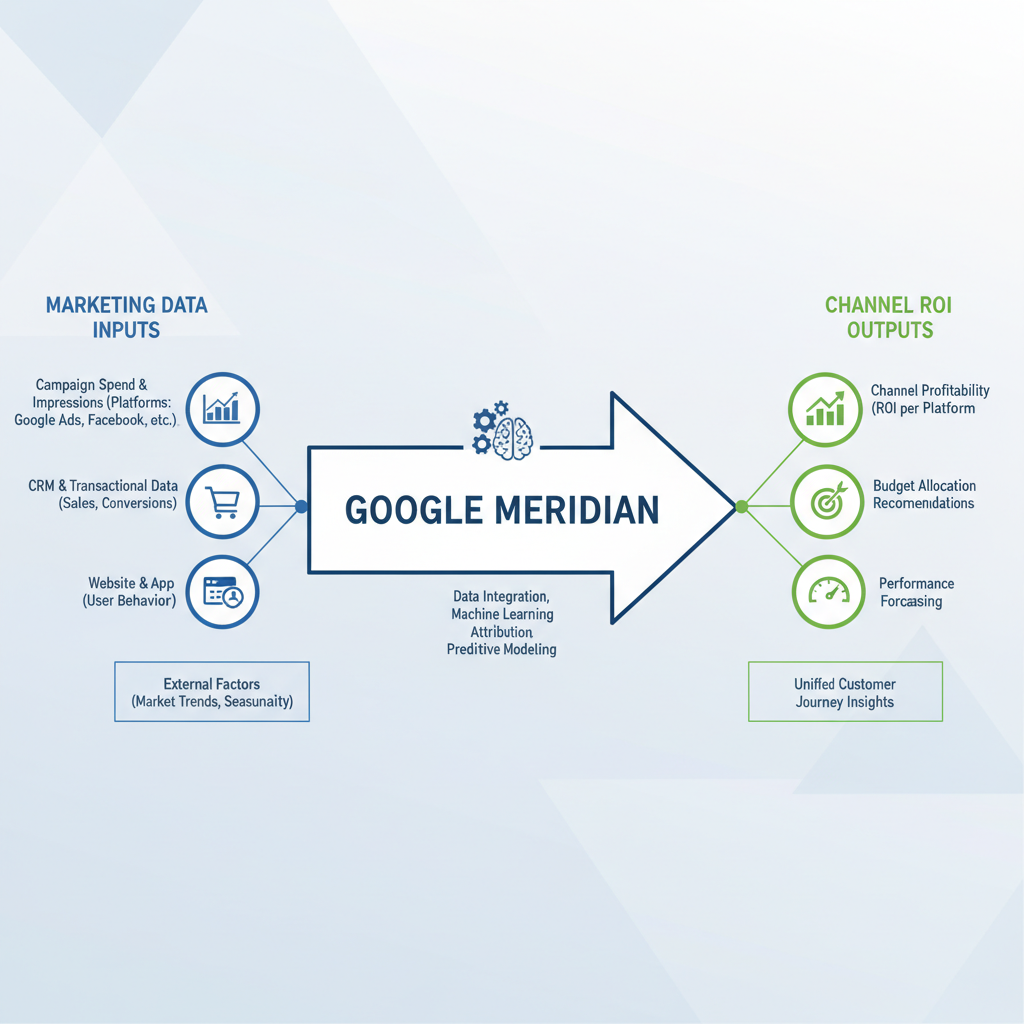
Meridian transforms raw marketing data into actionable channel ROI insights through Bayesian inference
Key Features of Google Meridian
1. Bayesian Causal Inference
Traditional regression-based MMMs give you single-number answers: "TV drove $2.3M in revenue." Meridian provides probability distributions: "TV drove between $1.8M and $2.9M with 90% confidence."
This uncertainty quantification matters. It tells you how confident to be in the results—critical for making budget decisions worth millions of dollars.
The Bayesian approach also lets you incorporate prior knowledge. If you've run incrementality tests showing search converts at 3% lift, you can feed that into the model. Meridian combines your experiments with historical data for more accurate outputs.
2. Advanced Adstock Modeling
Marketing effects don't stop when the ad does. A TV commercial today might influence purchases for weeks. Google Meridian models these carryover effects using sophisticated adstock decay functions.
Recent updates introduced binomial adstock decay—specifically designed for upper-funnel media where brand recall drives purchases long after initial exposure. Understanding funnel-stage dynamics helps you interpret these long-term effects correctly.
3. Saturation Curve Analysis
Every channel hits diminishing returns eventually. Spend $10K on Facebook ads, get great results. Spend $100K, and each additional dollar works less hard.
Meridian explicitly models these saturation curves, showing you where channels plateau. This directly informs budget optimization—helping you avoid overspending on saturated channels while finding underinvested opportunities.
4. Google Data Integration
Meridian provides native access to Google media metrics—impressions, clicks, costs, and reach data—through the same APIs powering Google's internal measurement. You also get Google Query Volume data showing organic search interest alongside paid search performance.
This integration eliminates a common MMM pain point: getting accurate Google advertising data into your model. The framework handles it automatically.
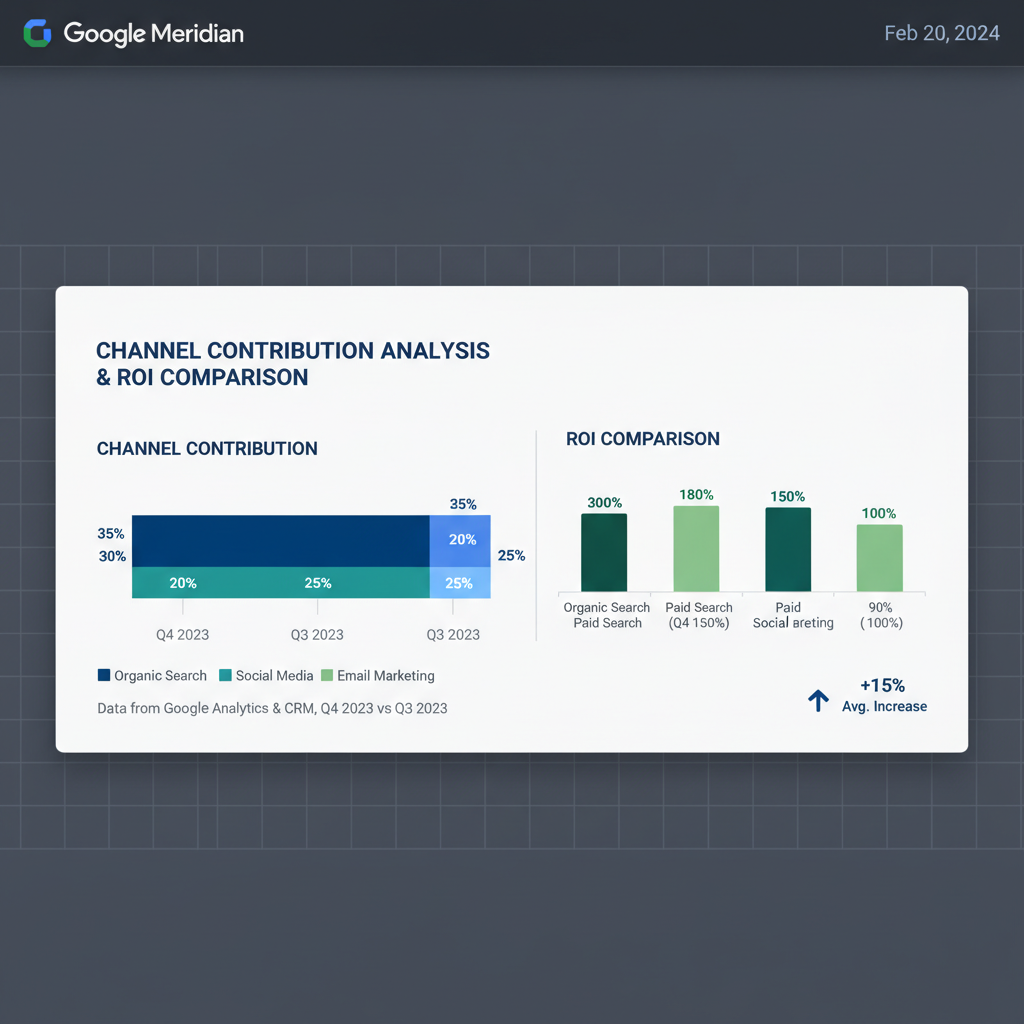
Meridian outputs include channel contribution decomposition, ROI rankings, and budget optimization recommendations
Getting Started with Google Meridian
Technical Requirements
Google Meridian isn't a SaaS platform—it's code you run yourself. Here's what you need:
System requirements:
- Python 3.11 or 3.12
- Minimum one GPU (NVIDIA recommended)
- 16GB+ RAM for typical datasets
- Linux or macOS environment (Windows via WSL)
Team requirements:
- Data scientist comfortable with Python and statistical modeling
- Marketing analyst who understands channel dynamics
- Engineer to set up infrastructure and pipelines
If these requirements seem daunting, you're not alone. Our preparation tips help you assess readiness before diving in.
Data Requirements
Like any marketing mix model, Meridian needs substantial historical data:
Essential data (minimum 2 years):
- Marketing spend by channel at weekly granularity
- Business outcomes (sales, revenue, conversions) at matching intervals
- Control variables (seasonality, promotions, pricing changes)
Recommended additional data:
- Reach and frequency metrics for video channels
- Impression data for display and programmatic
- Competitor spend estimates
- Economic indicators relevant to your business
Data quality matters more than quantity. According to Forrester research, poor data quality is the leading cause of MMM failure. Inconsistent tracking, missing periods, or incorrect spend allocation will undermine your results regardless of how sophisticated the model is.
Implementation Steps
Step 1: Environment Setup
Download Meridian from the official GitHub repository. Configure your Python environment with the required dependencies. Test GPU access and computational resources.
Step 2: Data Preparation
Format your data according to Meridian's schema. This typically involves:
- Aggregating daily data to weekly intervals
- Normalizing spend across channels
- Creating dummy variables for promotions and seasonality
- Handling missing data and outliers
Step 3: Model Configuration
Set priors based on your business knowledge. If you've run incrementality experiments, incorporate those results. Configure adstock decay parameters appropriate for your channels.
Step 4: Model Training and Validation
Run the model and evaluate outputs. Check that:
- Decomposition results pass sanity checks
- ROI estimates align with known benchmarks
- Uncertainty ranges are reasonable (not too wide or narrow)
- Out-of-sample predictions match actuals
Step 5: Insights and Optimization
Generate budget optimization scenarios. Use Meridian's planning tools to simulate different allocation strategies and forecast outcomes.
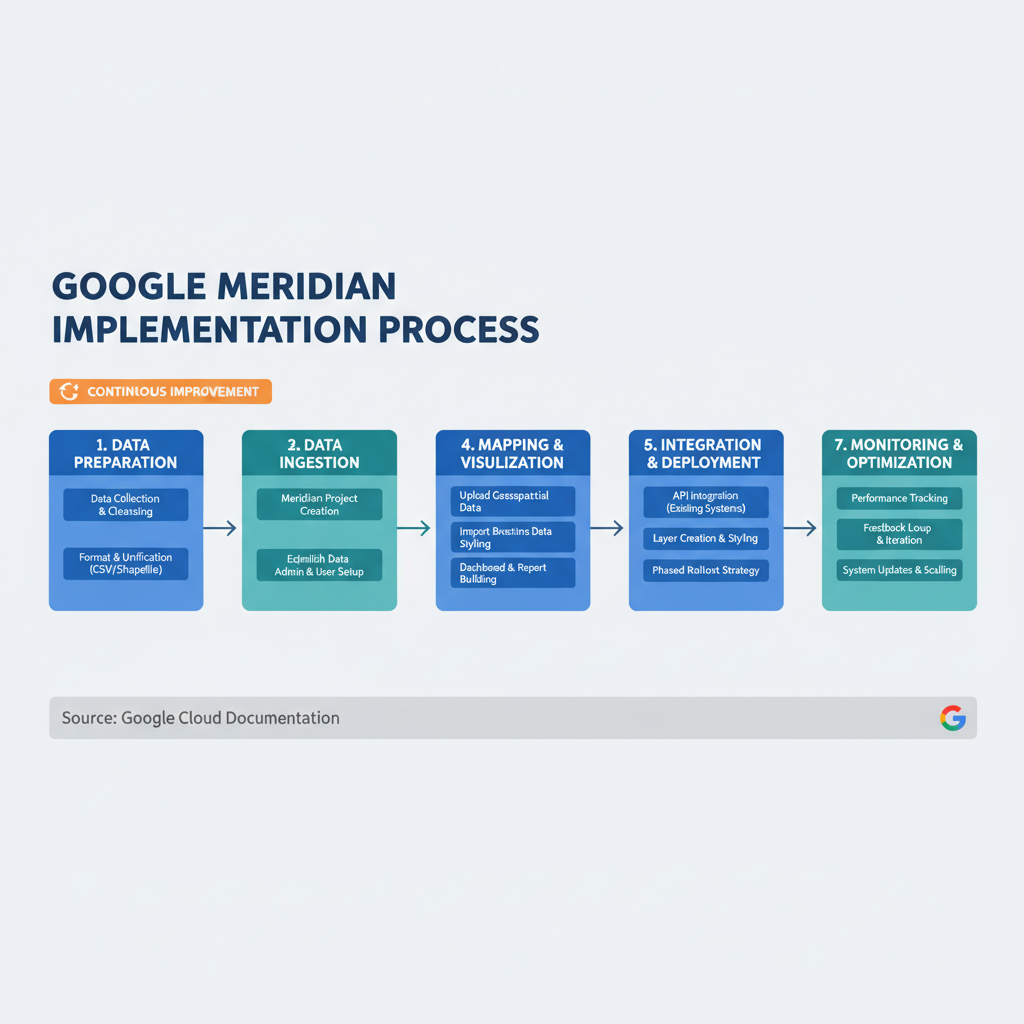
Successful Meridian implementation follows a structured process from data preparation through budget optimization
Google Meridian vs Meta Robyn
Both are open-source MMM frameworks. Both are free. How do they compare?
Google Meridian strengths:
- Bayesian methodology with uncertainty quantification
- Native Google advertising data integration
- More sophisticated search measurement
- Recent development (2025) incorporating latest research
Meta Robyn strengths:
- Established since 2021 with larger community
- R-based (more accessible to analysts)
- Automated hyperparameter tuning
- Extensive documentation and examples
When to choose Meridian:
- You spend significantly on Google advertising
- You want probability distributions, not point estimates
- Your team is Python-native
- You have incrementality data to calibrate against
When to choose Robyn:
- You need faster time-to-value with automation
- Your analysts prefer R over Python
- You want a larger community for troubleshooting
- You're newer to MMM and want more guardrails
Both tools have limitations. They require significant technical expertise and ongoing maintenance. Neither provides real-time optimization or handles the messy reality of campaign management without manual work.
Limitations and Challenges
Technical Complexity
Google Meridian isn't for non-technical marketers. You need data scientists who understand:
- Bayesian statistics and MCMC sampling
- Time series analysis and regression
- Python programming and data engineering
- Marketing domain knowledge
Without these skills, you'll struggle to configure the model correctly, interpret outputs meaningfully, or troubleshoot problems when they arise.
Resource Requirements
Running Meridian requires computational infrastructure—GPUs, storage, and processing power. For most organizations, this means cloud costs on top of the personnel investment.
Ongoing Maintenance
Models need updates as your business changes. New channels, shifting market conditions, creative strategy changes—all require recalibration. Expect to invest in ongoing model maintenance, not just initial implementation.
Google Bias Concerns
Some marketers worry about using Google's tool to measure Google's advertising. While Meridian's code is transparent and auditable, the concern isn't unreasonable. Cross-validate results with other measurement approaches when possible.
Best Practices for Success
Start with Clean Data
Invest time upfront in data quality. Audit your spend tracking. Verify conversion attribution. Document any anomalies or missing periods. Bad data produces bad models—no algorithm can fix fundamentally flawed inputs.
Our MMM checklist walks through data requirements in detail.
Calibrate with Experiments
Meridian shines when calibrated against incrementality tests. Run geo-lift experiments or holdout tests to establish ground truth for key channels. Feed those results into Meridian as priors for more accurate outputs.
Validate Constantly
Don't trust any model blindly. Check decomposition results against intuition. Compare ROI estimates to financial actuals. Test predictions against holdout periods. Healthy skepticism protects you from modeling errors.
Combine with Other Methods
Marketing measurement works best when triangulating across methodologies. Use Meridian for strategic allocation insights. Run incrementality tests for tactical validation. Layer in MTA where user-level data still works.
No single approach captures complete truth. Multiple perspectives converge toward better decisions.
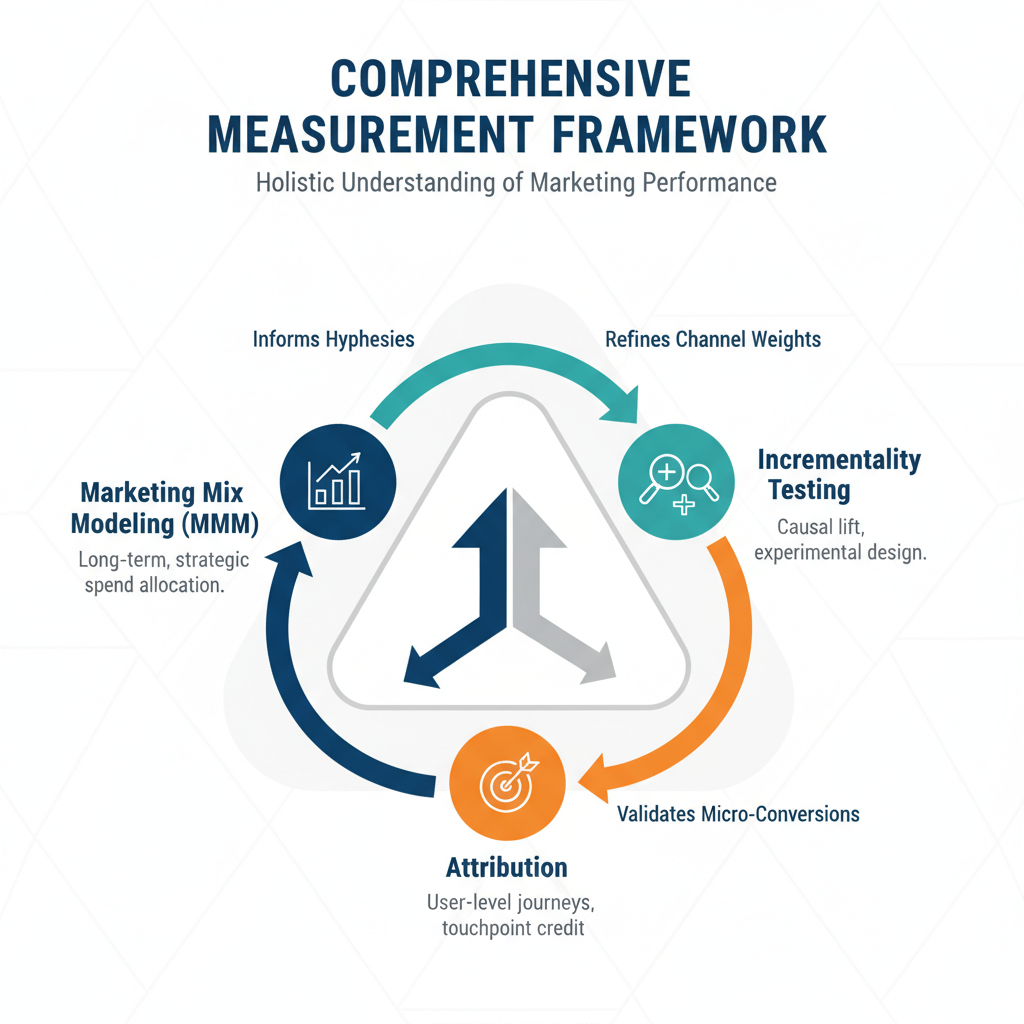
The most robust measurement strategies triangulate across multiple methodologies
Frequently Asked Questions
Is Google Meridian really free?
Yes—the software itself is free and open-source. However, you'll incur costs for compute infrastructure (cloud GPUs), personnel (data scientists to implement and maintain), and potentially consulting help for initial setup. The software is free; running it professionally isn't.
How long does Google Meridian implementation take?
Expect 3-6 months from kickoff to actionable insights. Data preparation typically takes 4-8 weeks. Model development and validation adds another 4-8 weeks. Building organizational capability for ongoing use takes additional time. Plan for a marathon, not a sprint.
Can I use Google Meridian without a data science team?
Not effectively. While Google offers certified partners who can help with implementation, you'll still need internal capability to interpret results, validate outputs, and integrate insights into decisions. Consider this a data science investment, not a marketing tool purchase.
How does Google Meridian compare to commercial MMM platforms?
Commercial platforms offer faster implementation, better UX, and ongoing support—at significant cost ($50K-$200K+ annually). Meridian offers comparable analytical power for free, but requires substantial internal investment. The total cost of ownership may be similar; the cost structure differs.
What data granularity does Google Meridian require?
Weekly data is standard. Meridian can handle daily data but weekly aggregation typically provides sufficient signal while reducing noise. You need minimum 2 years of history for stable results, ideally 3+ years covering different market conditions.
Does Google Meridian work for small businesses?
Generally no. MMM requires scale to produce meaningful results—both in marketing spend (typically $1M+ annually) and data volume. Small businesses are better served by simpler measurement approaches or working with agencies who can pool data across clients.
Conclusion
Google Meridian represents a significant advancement in accessible marketing measurement. Enterprise-grade methodology, open-source transparency, and zero licensing costs—it's a legitimate option for organizations with the technical capability to implement it.
Key takeaways:
- Meridian uses Bayesian causal inference for more accurate marketing measurement
- Implementation requires data science expertise, computational resources, and clean data
- Calibrating with incrementality experiments dramatically improves results
- The tool works best as part of a broader measurement strategy combining multiple approaches
- Free software doesn't mean free implementation—budget for personnel and infrastructure
For organizations with substantial marketing budgets and data science capability, Meridian deserves serious consideration. It provides measurement rigor previously available only through expensive vendors.
For those lacking internal data science resources, the calculus changes. Implementation complexity and ongoing maintenance requirements may outweigh the licensing savings.
Ready to assess your measurement readiness? Take our readiness quiz to evaluate whether you're prepared for advanced MMM implementation. For organizations seeking the benefits of sophisticated marketing measurement without the technical overhead, platforms like BlueAlpha.ai offer AI-powered solutions that deliver enterprise-grade insights through a more accessible implementation path—combining multiple measurement methodologies without requiring an in-house data science team.
Stay in the loop
Get updates on new posts and resources.